日本新一任首相、自民党总裁安倍晋三周末在接受专访时言语异常强硬,他声称各国政府竞相令本国货币贬值求生存,日本需要继续扩大量化宽松规模,同时上调通胀目标,以确保日元贬值,达到自我防卫目的。市场观察家忧心忡忡,认为日本此举恐将掀起全球货币大战。
即将出任日本首相的安倍晋三(Shinzo Ab)于12月23日接受电视专访呼吁日本央行(BOJ)更加强硬起来,对抗美国与欧洲争相竞贬本币的举措。安倍还指出,上周五日元汇率来到84.26价位,日元兑美元维持在90水平,才有助日本出口商实现盈利。
周一(12月24日)纽约交易时段,受安倍晋三激进言论影响,日本新一轮宽松预期空前高涨,日元汇率大幅贬值,刷新20个月新低。美元/日元逼近85关口,触及4月11日以来高点84.95。分析师预计日元将在2013年继续走低。
安倍在提及美联储(Fed)、欧洲央行(ECB)及英国央行(BOE)等西方央行持续疯狂印钞,大举购买国债与其他债券时指出:“全球各国央行竞相印钞救经济,提振出口,美国是最典型的例子。如果大家持续印钞,日元贬值将无可避免,日本起身对抗各国的这项举措是很重要的。”
安倍继续指出,美元/日元如果来到80价位,就像目前一样,而不是来到90价位,对日本企业来说则“完全是另外一回事”。安倍认为,如果美元/日元升破85,截至目前因没有赚钱获利而未缴税的企业,就有能力纳税。
安倍这番谈话是迄今以来对日元汇率水平最明确的表述,与此同时,全球各国则争相出招,不是令本币竞相贬值,就是入市干预阻止本币升值。
有些国家,向美国看齐,设法采行积极的货币宽松政策以救经济,其他国家则直接进场干预汇市,避免本币升值。金融危机爆发以来,包括瑞士、以色列和韩国在内的其他国家为了保护本国出口的竞争力纷纷加大政策力度防止本国货币过度走高。随着澳元的不断上涨,澳大利亚的决策者也面临同样的压力。
据交易商指出,韩国央行11月入场抛售韩元汇率,买进至少10亿美元,以阻升韩元汇率。韩国官员还警告,货币震荡“过大”恐不利韩国出口商。
此前包括英国央行行长金恩(Mervyn King)在内的人士警告指出,全球经济决策者正面临被卷入汇率战的危险,这可能会造成各国之间的紧张关系升级。“我忧心2013年将是充满挑战的一年,事实上,我们将看到一些国家设法压低本币,这实在令人忧心忡仲。”
在美国在一年期曾严厉批评日本当局频频入场干预日元汇率后,日本今年对汇市干预一直有所节制。安倍对干预举动也不以为然,他在11月指出,汇率干预“很难奏效”。
反之,安倍转而加大对日本央行施压力度,要求日银采取更积极的举措,其中包括实施无限额宽松,以摆脱长久的通货紧缩窘境,抑制日元升值。
安倍23日在专访中重申,要求日本央行在明年1月召开的决策会议上讨论设定2%通胀目标,并威胁若日银不从,将采取立法行动,修改央行法,迫使日银就范。
日本央行上周宣布,将在明年1月召开的例会考虑设定物价目标,并透露将采史无前例方案,提供商业银行廉价贷款,鼓励企业进行海外并购等。此次会议上,日本央行再次扩大10万亿日元资产购买规模,累计总额101万亿日元。
日本央行罕见坦承日银的举措目标直指日元汇率,旨在提振经济增长,促使某些货币专家争相对此发出警告。花旗银行(Citibank)首席外汇策略师高岛修(Osamu Takashima)警告,“货币宽松政策本身不构成问题,但与货币贬值挂钩,恐将被视为以邻为壑的政策。”
法国农业信贷集团(Credit Agricole)驻东京的外汇部门主管Yuji Saito表示,安倍内阁十分明智地向市场发出了这样一个信号:他们只是希望纠正日元的过度走强,并不想追求日元汇率贬值。1美元兑85-90日元对每个人来说应该都是一个适宜的区间,包括出口商、进口商、银行以及韩国和美国等国际伙伴。
Tuesday, December 25, 2012

法国巴黎银行:建议逢高抛售美元
汇通网12月25日讯——周二(12月25日)亚市盘中,美元指数小幅走低,现交投于79.60一线。法国巴黎银行称,建议逢高抛售美元。由于围绕美国财政悬崖的不确定性依然存在,投资者目前只零星建立了风险头寸。
法国巴黎银行策略师 Michael Sneyd 称,认为新年澳元兑美元(1.0413,0.0057,0.55%)将走高,同时预计加元和英镑将得益于美元疲软。
陶冬:2012一场玩转全球的QE大冒险
——专访知名经济学家、瑞士信贷董事总经理陶冬
死罪可免,活罪难逃。
即将过去的2012年,全球经济走得可谓艰难。欧债危机硝烟再起,中国出现了增长“降档”,加上美国年底面临的陡峭“财政悬崖”,世界经济复苏再次频频亮起红灯。
危难之际,央行再一次扮演了救世主的角色。从欧元区、到巴西、到澳大利亚、中国,降息再次被决策者们频频动用。美联储在今年9月13日宣布正式启动QE3,将这轮量化宽松浪潮推向了新的高潮,三个月后,QE4不期而至。同时加入QE竞赛的还有英国、欧元区和日本。
2012年的最后几周,伴随着“世界末日”的喧嚣,世界经济反倒是依稀重现了失去多时的“正能量”。即将开始的2013年,世界经济会否一举重拾动能?量化宽松的浪潮又将如何发展?带着这些广大读者关心的疑问,上海证券报记者日前专访了知名经济学家、瑞士信贷董事总经理陶冬。
美国“财政悬崖”可控 “财政斜坡”难躲
上海证券报:记得一年前的这个时候您曾对我说过,全球经济不确定性持续上升,增长进一步放缓。那么眼下您又会怎样来评价明年的形势的呢?谁会脱颖而出?谁又会拖后腿?
上海证券报:记得一年前的这个时候您曾对我说过,全球经济不确定性持续上升,增长进一步放缓。那么眼下您又会怎样来评价明年的形势的呢?谁会脱颖而出?谁又会拖后腿?
陶冬:我对明年经济的判断是,不确定性开始减少,但全球增长依然乏力。全球的增长前景明年会有所改善,不确定性有所下降,这可能是明年最大的好事。相对2012年,过了财政悬崖之后,美国的增长不确定性会少一些,中国的增长不确定性也会少一些。但是增长的力度并不强。
欧洲已经在衰退,日本也在衰退之中,明年会陆陆续续从衰退中爬出来。美国经济会不会衰退,取决于财政悬崖问题的解决,如果财政悬崖问题不是很“壮烈”的话,相信美国经济明年还可以实现2%的增长。
上海证券报:提到欧债就不能不提财政悬崖,您觉得美国会落崖么?
陶冬:这段时间大家谈得最多的是美国的财政悬崖。在我看来,美国存在“财政斜坡”,但悬崖是没有的。因为美国的财政问题目前是可控的。
今天和去年11月的最大区别是,美国大选已结束,两党的党争还会有,但不会是死去活来、你死我活之争。我相信财政悬崖的两党谈判道路会非常曲折,不排除到年底或者年底后的那一天还没有达成协议。但美国是一个白宫、一个国会、一个美联储,到最后可以达成一个协议。至于能否找出一个可持续的可靠解决方案,我没有信心。但只要他们愿意把问题往后拖一年,至少就会对美国是正面的影响。因为过了财政悬崖后,美国经济的不确定性会大幅减少。
欧洲
希腊西班牙警报暂缓 最担心法国
希腊西班牙警报暂缓 最担心法国
上海证券报:欧债危机似乎出现了缓解,金融市场也有回暖迹象,您是否还认为欧债是个大问题呢?
陶冬:欧洲曾经一度弥漫着硝烟,大家认为欧债危机在迅速恶化,欧元有一天也许会破产。但过去三个月,欧债危机逐步向好的方向发展,欧洲国家发债成本明显下降。这一切都功归于欧洲央行,归功于德拉吉。我们相信,随着希腊救助金发放,西班牙局势的暂时稳定,欧债危机进入了一个相对的缓冲期。
但我们目前看到的,不过是恐慌峰值之间的一段平静。欧债危机并未真正结束,欧债危机的核心是财政收支结构性的缺陷,只有通过增加财政收入、减少公共开支来解决,靠货币政策不可能得到真正解决。
美、日、欧三大经济体中,欧洲的债务总量是最少的,债务占GDP的比重也是最低的,但危机恰恰在欧洲,为什么?因为欧洲是邦联政治体系,美国是联邦,日本是中央政府。中央和地方之间的关系是老子和儿子的关系,儿子掉河了,老子肯定会跳水去救。但德国和西班牙、希腊只是邻居关系,救救急可以,但要跳水舍命相救不大现实。最近欧洲领导人会开会讨论建立欧洲银行联盟和更严格的财政纪律,但这些都只是一部分,更重要的是财政支付补贴,换句话说,经济上强劲的德国愿意资助弱小的国家。由于邦联的政治体系,短期内德国可能愿意付一点钱,但钱永远付不够。10年以内欧元破产仍有可能,眼下只是中场休息。
上海证券报:明年来说,有没有什么时间点让您担心?或者说,有没有谁可能成为下一个希腊?
陶冬:明年2月到4月份,西班牙有大量国债需要续期,那个时候,西班牙问题可能卷土重来;另外一个是,意大利总理蒙蒂已宣布辞职,这会给意大利在明年2、3月大选前后带来新的不明朗因素。但对我而言,欧债危机最让人担心的是法国。目前为止,所有人都把法国和德国并列为欧洲的两大核心国家,是欧洲稳定的支柱。但实际上法国经济基本面在迅速恶化,到明年年中,法国的失业率可能达到13.5%;法国经济中的消费和税收对失业率非常敏感,一旦经济下滑,法国的财政收入状况会比目前的预期差很多。一旦评级机构对法国进行第二轮评级调整,明年法国出事才是欧洲我最担心的事情。
日本
量化宽松重心由美国转向日本
量化宽松重心由美国转向日本
上海证券报:量化宽松是2012年贯穿始终的主线,展望2013年,QE似乎仍是主基调之一。您怎么看明年主要发达经济体明年的货币政策调整?
陶冬:我认为,量化宽松政策的重心接下来将从美国转向日本。
除非美国真的跌落财政悬崖,明年美联储可能不会再加大宽松措施,这也将是自金融危机爆发以来头一回,美国没有在新的一年中祭出新的宽松政策。
相比之下,日本央行的货币政策可能向盯住通货膨胀转移,尤其是安倍当选首相后,日本央行的量化宽松幅度可能会增加。过去是每个月固定的债券购买计划,以后可能变为,在没有达到既定通胀目标之前,央行每个月将购买不设上限的国债,通过这一途径来注入流动性。
实际上,美国量化宽松最强烈的时期可能已经过去,基本上就维持目标的水平。但日本可能在增加新的流动性。
中国经济一时半会还快不起来
陶冬是我认识的国内经济学家中,对国际经济形势看得最透、最准的一个。但作为瑞士信贷的亚洲区首席经济学家,陶冬对中国经济的深刻认识才是他的“金字招牌”。
观察近期的固定投资等指标,陶冬认为,中国经济已经见底。不过,在他看来,当前几乎所有的增长反弹动力都来自基础设施。换句话说,今天拉动经济企稳回升只有一个动力——公共开支。
“中国经济的核心问题没有得到解决,民间投资消失了。哪怕是现在经济企稳,民间投资还是没有出现。”陶冬直言。“少了民间投资,中国经济今后几年也就是8%左右的增长,快不起来。”
今年11月份,中国的工业生产重新反弹至两位数增长。很多人都为此欢呼雀跃。但陶冬认为,任何人要是对于中国经济可能重新回到过去两位数的强劲增长抱有“奢望”,甚至依此投资,最终肯定会失望,会输得很惨。
“今天中国经济没有V型反弹的底气和动力,也不会有V型反弹的政策。更可能出现的是1997年到2003年我们所见到的一个长期的底。”
今天中国迫切需要的,在陶冬看来,是结构性的改革。回顾历史,上世纪80年代初,百废待兴,中国推出了农村改革,以体制上的突破,带来生产力上的突破,带来了6年左右的好光景。90年代初,经济再次出现僵局,邓小平提出了开放经济特区,吸引外资流入,为中国成为“世界工厂”奠定了基础。本世纪初,中国经济再次陷入泥沼,并且碰上亚洲金融危机,中国适时加入WTO,又是以体制上的突破带来了结构上的变化,拉动了生产力的提高。
“今天,中国已消耗前几次结构性改革带来的红利,迫切需要一次新的体制上的突破。”陶冬说。中国政府显然也意识到了这个问题,2007年就提出了经济转型。但刚好碰到了西方金融危机。陶冬认为,在这期间,中国也或多或少受到西方印钞和财政刺激的影响。
在陶冬看来,这些反周期的扩张政策,可以“托一托经济的底,让经济增长没有那么难看”,但是很多这些政策,都是在维持,不是在突破。“少了体制上突破,就没有生产力的提高,经济就很难有突破,中国就很难回到过去我们习以为常的那个勇猛的中国。”
scalping using hedging
The stategy:
look for the cross on MACD both settings, try to confirm with higher time frames. Price action should be a good distance from the 200ema. For a short position (my favorite since tops tend to form more quickly than bottoms) place a sell order (use a limit if that would get a better entry).
Then place a buy limit instead of a stop just above the high that occurred in concurrence with the MACD crosses.
The idea is that if indeed this wasn't the actual turning point and there is still a little more upside to go before the price action turns down for real, the upside can be turned into a small profit using a hedge, instead of a loss using a stop. The important thing is to get out of the buy position right away if it does trigger. As soon as there is any sign of the buying slowing. Could be 5 pips, 10 pips, whatever. Don't want to get caught in the buy position when it does turn down. Very often this little last spurt of buying will take place, a new high is created and there is very obvious divergence in the MACD, especially the default setting. A new short position can be taken at this point with 2 buy limits just above the high that was just created. This can be repeated a few times. But eventually the turn down comes. Checking higher time frames for confirmation of a down turn before even entering this trade is important. After practicing a few times it gets easier to identify this set up.
Benefits are, losses are turned into gains. And several positions are profitable on one set up. Losses are minimized if the unforeseen twist of fate derails the whole thing. The losses are limited to simply the differences between the long and short positions and the cost of spreads.
The more the trade goes against the original short and runs wild high temporarily the more of a profit from the hedged long, and when it turns the shorts are all good. Even if it is a retracement and not a reversal and doesn't retrace all the way to original short position, it can still be profitable overall.
The extra added benefit and for me a very significant benefit is the noticeable lack of fear and stress by having the hedges in place. No run away losses. In fact those so called losses are actually now profits.
The best thing of course is to hit it on the head, get it perfect, and enter short at the very top. Happens every now and then. But when it doesn't, hedging is great.
The following charts show 1st the original set up and then how it played out with the brief spurt of additional buying just before the final turn down and how the hedged buy limit acted to turn a potential loss into a profit.


Useful FOREX Hedging Strategies
What Is Hedging?
Hedging is essentially placing a bet in both directions of the market. You are placing a buy and a sell order on the same currency. Therefore, you could potentially profit from movement in either direction. If done properly, hedging can be a way to maximize profits and minimize risk from big market moves.
Pending Orders
One very popular way to implement hedging in FOREX trading is to use pending orders. With pending orders, you can place an order that will be filled when the market price reaches a certain level. You can place a pending order at a price above or below the current market price. Pending orders and hedging can be used in several other FOREX trading strategies.
Range Trading
One strategy that implements both hedging and pending orders involves a daily range method. With this method, you need a currency with a relatively small daily range. The currency needs to move in a relatively straight pattern across the chart. You want it to move up and then back down within a certain range consistently.
Figure out the ranges in which it normally reverses direction. Place a pending buy order below the market price on the point where it tends to reverse, going back toward the top of the range. Place a sell order at the top of the range. This way, you can profit from the trends of the currency.
Breakout Method
Another way to utilize hedging and pending orders is to use a breakout method. This type of strategy works better on a currency that tends to trend instead of range. If the market is going rather sideways at the moment, this can be a good time to implement this strategy. Place a pending buy order above the market and a pending sell order below the market. Then, when the market chooses a direction, you can benefit from the move. You will be covered if it jumps up or plummets suddenly.
Hedging is essentially placing a bet in both directions of the market. You are placing a buy and a sell order on the same currency. Therefore, you could potentially profit from movement in either direction. If done properly, hedging can be a way to maximize profits and minimize risk from big market moves.
Pending Orders
One very popular way to implement hedging in FOREX trading is to use pending orders. With pending orders, you can place an order that will be filled when the market price reaches a certain level. You can place a pending order at a price above or below the current market price. Pending orders and hedging can be used in several other FOREX trading strategies.
Range Trading
One strategy that implements both hedging and pending orders involves a daily range method. With this method, you need a currency with a relatively small daily range. The currency needs to move in a relatively straight pattern across the chart. You want it to move up and then back down within a certain range consistently.
Figure out the ranges in which it normally reverses direction. Place a pending buy order below the market price on the point where it tends to reverse, going back toward the top of the range. Place a sell order at the top of the range. This way, you can profit from the trends of the currency.
Breakout Method
Another way to utilize hedging and pending orders is to use a breakout method. This type of strategy works better on a currency that tends to trend instead of range. If the market is going rather sideways at the moment, this can be a good time to implement this strategy. Place a pending buy order above the market and a pending sell order below the market. Then, when the market chooses a direction, you can benefit from the move. You will be covered if it jumps up or plummets suddenly.
Wednesday, December 19, 2012
Forex Strategy Hedge Hog
Forex Strategy Hedge Hog is not just a simple and very easy forex strategy, not requiring little or no knowledge in forex trading, all you need - to know the basics of trading platform Metatrader 4, and strict adherence to very simple rules strategy …
I recommend selecting a Broker Forex with Terminal MetaTrader 4
Thus, the essence of strategy Forex Hedge Hog:
Every day at 00:00 GMT (5 days a week - Monday to Friday) opened two trading positions on EURUSD currency pair in opposite directions: on the Buy and Sell on equal lots.
It should be noted that not all forex brokers allow you to open trade in opposite directions, so that possible solutions to this problem is to open 2 accounts and trade on different terminals. Ideally suited as a company Forex4you (always allows you to open the transaction in the opposite direction)!
At the same stop-loss set does not need!
Fits only take profit away 14 points from the entry price into the market.
And as strange, but Most of the trading days will bring you a profit of 28 points.
This amount of profit was not chosen by accident - conducted the analysis on historical data, it was observed that the rate of profit in 14 points:
Buy orders were profitable in 83.5% of cases
Sell orders were profitable in 85.7% of cases
The risk that, in general none of the public order will not be closed with a profit of 14 points in the same trading day, was only less than 1.5%.
More than 80% of trading positions are closed with a profit during the same trading day.
About 95% of trading positions, not closed with profits on the same trading day, closing within 1-3 business days (and thus very often - on the next trading day).
If 1 or 2 trade positions are not closed with a profit within 48 hours after opening, it must be closed manually! And after that, the size of the trading position is in WAY unprofitable transaction on the next trading day should be increased by a factor of 2 (ie if 48 hours have passed and you shut down an unprofitable transaction manually in the 0.00 to GMT, then immediately after closing, opens up new, but one of them uvelichina 2 times).
IMPORTANT: If at least one of the positions are not close during the trading day - on the following day the new orders will not open at all!
Statistics for the last month (from 3 to 31 August 2009 inclusive):
Number of points earned - 504
Number of closed items with a loss - 56
Total income per month - 448 points!
At the end of forex strategy you can find forex indicator for MT4, which helps you to visually define the borders zakytiya profits and thus evaluate the performance of this strategy Forex Hedge Hog (if the red or blue line broken at least one item, so the deal was closed on take- profit). Look better on the hour interval.
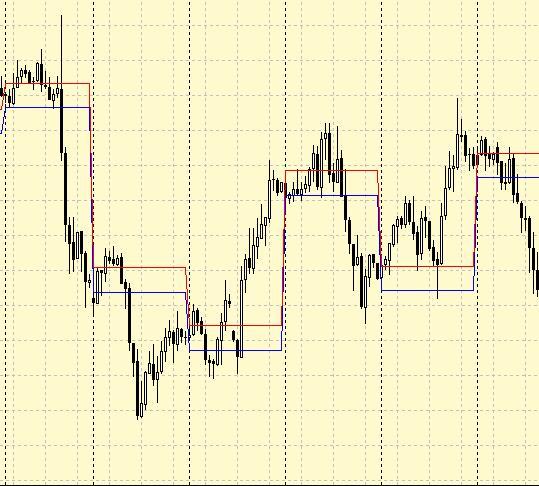
The variables in the indicator as follows:
Offset = 14 - the value of a take profit.
TimeZoneOfData = 0 - time schedule - GMT 0.
Download forex indicator for MT4 - HedgeTest.mq4
Also see an updated version of forex strategy Hedge Hog - 2!
By this strategy, forex you can
FREE DOWNLOAD:
Councilor Forex Hedge Hog 2
(in the kit you get 2 Councillor: Hedge Hog ver.1 + Hedge Hog ver.2)
Warning: forex advisor before being sold in the store Plati.ru and was withdrawn from sale 4/11/2010, as the market has changed and advisor Forex Hedge Hog 2 ceases to give a stable result.
At this point you can use it for free and try to pick up options on their own to any other currency pair!
See here: How to test and optimize forex advisor Metatrader 4?
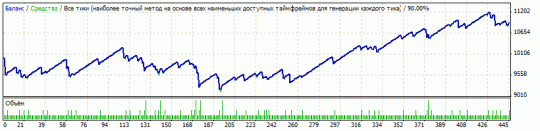
Hedge Hog version 1 - take profit = 20 points:
Helge Hog version 2 - constant volume ofLot 0,1:
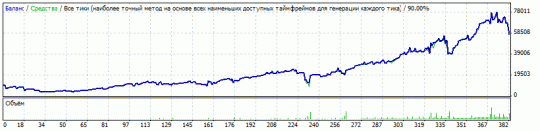
Helge Hog version 2 - danamicheski changes the volume of transactions (more risky way to trade - are large drawdowns)

100% hedging system with two brokers
I am experimenting with 100% hedging system ran on two brokers accounts. One broker pays/charges swap and the other does not (or very small). It is not a new discovery and there are basically two problems:
- swap trades requires to have big account, at least $10K+
- find reliable broker with low or no swap
I can find good brokers that pay swap, like FXDD, InterbankFX or Alpari. I found one that does not charge big swaps or no swaps at all. It is ODL Securities. They look like a big reliable and reputable company, but I have no experiences with them so I just experiment with their demo account. It's been a couple of days since I have no swap on all my open positions. I wonder if that works like that when I have live account.
Now, the strategy: most of people take the pair with biggiest swap and open only that one. My strategy is to open 15 - 20 pairs, so they hedge themselves a bit (one goes up, one goes down...). If I would open only 15 lots GBPJPY and it fluctuates 500 pips in a few days that would blow up one of my accounts, but having opened 15 pairs can let me keep my swap trades opened for weeks, possibly, which is what we want in order to collect swap.
So, I open at e.g. Alpari 18 pairs (1 lot each), each pair in the direction of positive swap. At the same time I also open the same pairs and lots at ODL Securities, but in oposite direction than at Alpari. This way my trades are 100% hedged.
For example:
Alpari: EURUSD - sell, ODL: EURUSD - buy
Alpari: USDJPY - buy, ODL: USDJPY - sell
I then let it open for as long as possible. When one of my account's margin is close to 100% I should close all the trades. Then withdraw the money from winning account and fund losing account. The difference of winning vs. losing is my profit. The profit is positive swap + sometimes there are pricing discrepancies between broker quotes that work in my favour.
Now, how big profit I can get? Depends how much I can fund my account, but in percents it is around 8% per month (only swap), which is not that bad, especially when considering there is no risk, since it is 100% hedge. The only risk is the broker company where you have your money.
I opened 18 positons at Alpari and ODL securities on June 16 and today's balances are like this:
Alpari: +$11,112
ODL Securities: -$8,128 (free margin 396% yet)
======================================
TOTAL: +$2984 (it is only 6 days opened, daily swap is +$140)
I have standard demo accounts there with $100K, but $50K would be enough for these numbers. So, if I had $5K live accounts, I would be nearly $300 in profit just in 6 days.
It is obvious the profit is not just swap (currently swap profit is $566), it looks like price feeds are different and they play in my favour.
I would like to ask the audience what you think about this system and if you have any experiences with ODL Securities. I would be able to have 2 $5K accounts, but I am careful where I put my money.
I also have a EA that opens and closes all the positions. Pairs can be edited in external text file so opening and closing is just a matter of one click, actually.
This is not a correlation hedging system, this is 100% hedge. In this system your risk is 0 (zero) as long as you work with honest brokers.
Let me explain you again on two pairs only (no correlation required). What I do I open on Alpari
1 lot EURUSD short
1 lot GBPJPY long
On ODL Securities I open:
1 lot EURUSD long
1 lot GBPJPY short.
So, if EURUSD goes up then I lose on Alpari but I win on ODL. The result is $0 (if for simplicty I exclude spread). Whereever the price goes, my positions sum in $0 P/L.
Where is the profit? Alpari pays swap interest per position opened. ODL does not charge or charges very little.
Brokers do not mind keeping positions opened as long as your margin is more than 100%. That is the point when we close all postions. For every day that we have positions opened we earn interest. That is the whole point.
The swap is paid by brokers. Different brokers have different swap policy. Some of them have fixed daily rates (like Alpari or IBFX), some of them close all postions on day close and re-open on day open. They pay/charge only difference of the rollover swap rates (like ODL). I found out that swaps are smaller or none with the latter system.
- swap trades requires to have big account, at least $10K+
- find reliable broker with low or no swap
I can find good brokers that pay swap, like FXDD, InterbankFX or Alpari. I found one that does not charge big swaps or no swaps at all. It is ODL Securities. They look like a big reliable and reputable company, but I have no experiences with them so I just experiment with their demo account. It's been a couple of days since I have no swap on all my open positions. I wonder if that works like that when I have live account.
Now, the strategy: most of people take the pair with biggiest swap and open only that one. My strategy is to open 15 - 20 pairs, so they hedge themselves a bit (one goes up, one goes down...). If I would open only 15 lots GBPJPY and it fluctuates 500 pips in a few days that would blow up one of my accounts, but having opened 15 pairs can let me keep my swap trades opened for weeks, possibly, which is what we want in order to collect swap.
So, I open at e.g. Alpari 18 pairs (1 lot each), each pair in the direction of positive swap. At the same time I also open the same pairs and lots at ODL Securities, but in oposite direction than at Alpari. This way my trades are 100% hedged.
For example:
Alpari: EURUSD - sell, ODL: EURUSD - buy
Alpari: USDJPY - buy, ODL: USDJPY - sell
I then let it open for as long as possible. When one of my account's margin is close to 100% I should close all the trades. Then withdraw the money from winning account and fund losing account. The difference of winning vs. losing is my profit. The profit is positive swap + sometimes there are pricing discrepancies between broker quotes that work in my favour.
Now, how big profit I can get? Depends how much I can fund my account, but in percents it is around 8% per month (only swap), which is not that bad, especially when considering there is no risk, since it is 100% hedge. The only risk is the broker company where you have your money.
I opened 18 positons at Alpari and ODL securities on June 16 and today's balances are like this:
Alpari: +$11,112
ODL Securities: -$8,128 (free margin 396% yet)
======================================
TOTAL: +$2984 (it is only 6 days opened, daily swap is +$140)
I have standard demo accounts there with $100K, but $50K would be enough for these numbers. So, if I had $5K live accounts, I would be nearly $300 in profit just in 6 days.
It is obvious the profit is not just swap (currently swap profit is $566), it looks like price feeds are different and they play in my favour.
I would like to ask the audience what you think about this system and if you have any experiences with ODL Securities. I would be able to have 2 $5K accounts, but I am careful where I put my money.
I also have a EA that opens and closes all the positions. Pairs can be edited in external text file so opening and closing is just a matter of one click, actually.
This is not a correlation hedging system, this is 100% hedge. In this system your risk is 0 (zero) as long as you work with honest brokers.
Let me explain you again on two pairs only (no correlation required). What I do I open on Alpari
1 lot EURUSD short
1 lot GBPJPY long
On ODL Securities I open:
1 lot EURUSD long
1 lot GBPJPY short.
So, if EURUSD goes up then I lose on Alpari but I win on ODL. The result is $0 (if for simplicty I exclude spread). Whereever the price goes, my positions sum in $0 P/L.
Where is the profit? Alpari pays swap interest per position opened. ODL does not charge or charges very little.
Brokers do not mind keeping positions opened as long as your margin is more than 100%. That is the point when we close all postions. For every day that we have positions opened we earn interest. That is the whole point.
The swap is paid by brokers. Different brokers have different swap policy. Some of them have fixed daily rates (like Alpari or IBFX), some of them close all postions on day close and re-open on day open. They pay/charge only difference of the rollover swap rates (like ODL). I found out that swaps are smaller or none with the latter system.
Does Your Forex Broker Really Want You To Profit?
Less than a decade ago in 1999, retail or individual forex trading simply did not exist. Trading the foreign exchange markets was pretty much restricted to big banks, hedge funds, and high net-worth individuals simply because of the capital requirements for trading. The minimum trading size was usually $1,000,000 USD.
However, as information began spreading about the profit potential that forex trading holds, more people wanted in, even if they could not trade on the traditional interbank market because they did not have huge sums of money to work with.
There was a growing need for forex market access for those investors who had around $10,000 to $50,000 to invest or less, and so the retail forex market was born. New forex brokers began (and still are) springing up rapidly to meet this high demand, yet this aspect of forex trading is still highly unregulated.
Many of the forex brokers out there operate under the 'market maker' or bucketshop model, and these are the guys who actually have NO interest in seeing you succeed as a trader. Why, do you ask?
Well, it is their job to make forex market access available to smaller investers (hence the term market maker). In order to do that, they need to be able to fill every order that you place on your trading platform, and they do this by taking the opposing position of every trade that you make.
Well, since they will have an opposing position open for every trade that you make, they will actually lose money every time you have a winning trade. Imagine that you bought the EUR/USD pair because you think the Euro is going to appreciate. Well, in order to provide market access to you, the broker will have to take a position where they are selling EUR/USD in order for your trade to go through.
Since they are in a sell position here, it is in their best interest for the Euro to depreciate in value, or to see you lose on the trade. And keep in mind that your forex market maker will never, ever reveal this to you, as they count only a small minority of traders actually fully understanding their business model, and thus the majority of traders will fall victim to it.
The other type of forex broker business model is called an Electronic Communications Network (ECN), and it is more trader-friendly simply because the broker does not have a vested interest in seeing you fail. In order to understand how this type of setup works, remember that the goal of any broker is to provide market access and liquidity.
A forex market maker does this by taking an opposing position to every trade you place, but an ECN broker does this buy routing your trade order through their communications network and matching it with another trade (for example, if you placed a buy order on a certain currency pair, the ECN would match you up with another trader selling that same pair).
ECN brokers are really your best choice, as it is much easier to make money using a broker that offers this type of trading setup. Because they have no vested interest in seeing you lose money and instead only care about providing a network where they can match your orders with other traders, you would never have any problems withdrawing your profits as you might have with a market maker.
However, as information began spreading about the profit potential that forex trading holds, more people wanted in, even if they could not trade on the traditional interbank market because they did not have huge sums of money to work with.
There was a growing need for forex market access for those investors who had around $10,000 to $50,000 to invest or less, and so the retail forex market was born. New forex brokers began (and still are) springing up rapidly to meet this high demand, yet this aspect of forex trading is still highly unregulated.
Many of the forex brokers out there operate under the 'market maker' or bucketshop model, and these are the guys who actually have NO interest in seeing you succeed as a trader. Why, do you ask?
Well, it is their job to make forex market access available to smaller investers (hence the term market maker). In order to do that, they need to be able to fill every order that you place on your trading platform, and they do this by taking the opposing position of every trade that you make.
Well, since they will have an opposing position open for every trade that you make, they will actually lose money every time you have a winning trade. Imagine that you bought the EUR/USD pair because you think the Euro is going to appreciate. Well, in order to provide market access to you, the broker will have to take a position where they are selling EUR/USD in order for your trade to go through.
Since they are in a sell position here, it is in their best interest for the Euro to depreciate in value, or to see you lose on the trade. And keep in mind that your forex market maker will never, ever reveal this to you, as they count only a small minority of traders actually fully understanding their business model, and thus the majority of traders will fall victim to it.
The other type of forex broker business model is called an Electronic Communications Network (ECN), and it is more trader-friendly simply because the broker does not have a vested interest in seeing you fail. In order to understand how this type of setup works, remember that the goal of any broker is to provide market access and liquidity.
A forex market maker does this by taking an opposing position to every trade you place, but an ECN broker does this buy routing your trade order through their communications network and matching it with another trade (for example, if you placed a buy order on a certain currency pair, the ECN would match you up with another trader selling that same pair).
ECN brokers are really your best choice, as it is much easier to make money using a broker that offers this type of trading setup. Because they have no vested interest in seeing you lose money and instead only care about providing a network where they can match your orders with other traders, you would never have any problems withdrawing your profits as you might have with a market maker.
Monday, December 17, 2012
A Trader’s True Allies: Making Millions the Livermore Way
Many don’t realize it, but Jesse Livermore was the original “global macro” guy.
He would trade anything back in the day — stocks, wheat, cotton, coffee, options contracts — and he surely would have traded currencies too, had the world not been on the gold standard.
Livermore, whose ideas and approaches were immortalized via Reminiscences of a Stock Operator in 1923, is widely recognized as one of the greatest traders ever… his life and times contributing to the greatest trading book of all time.
Livermore has long been one of our “mentors from afar.”
Our broad trading approach — long / short with a global macro overlay — is much modeled after his. (Along with later global macro greats who operate in the Livermore mold, such as Soros, Druckenmiller, Kovner, Bacon and Jones.)
Getting back to Livermore, it struck me how valuable the wisdom of Reminiscences has proven in this tape. Having gotten more involved on StockTwits and Twitter lately — and you should follow us if you aren’t already — it has grown apparent the great degree to which others can benefit from Livermore’s wisdom.
And by “others” I mean (ahem, cough cough) those who tried to be wiseguys this week, picking Thursday tops and bottoms in TLT and SPY, and thusly getting their heads handed to them.
Let’s go through a few classic Reminiscences quotes and see how they’ve applied to this market:
But I can tell you after the market began to go my way I felt for the first time in my life that I had allies — the strongest and truest in the world: underlying conditions. They were helping me with all their might. Perhaps they were a trifle slow at times in bringing up the reserves, but they were dependable, provided I did not get too impatient.
Being a contributor to the StockTwits and Twitter Stream, one of the things that consistently amuses and confuses yours truly is the lack of regard for underlying conditions.
Underlying conditions — also referred to by Livermore as “general conditions” — represent the flow of what is going on in the world.
Here it is again, in plain English:
I still had much to learn but I knew what to do. No more floundering, no more half-right methods. Tape reading was an important part of the game; so was beginning at the right time; so was sticking to your position. But my greatest discovery was that a man must study general conditions, to size them so as to be able to anticipate probabilities.
Underlying / general conditions encompass not just technicals — Livermore didn’t use charts, though he watched price action like a hawk — but fundamentals and sentiment too… a sense of which way the world is going and why.
Back to present day: For a macro oriented trader who pays attention to underlying conditions, it seems crystal clear which way the wind has been blowing.
In a recent piece on Gold vs Bonds, we laid out extensive drivers, along with story links, as to what was happening. Namely, the world is slowing down (as Europe slowly falls apart)…
In short, paying attention to underlying conditions can save you a lot of money — or MAKE you a lot of money — if you consistently make an effort to put the puzzle pieces together (technicals, fundamentals and sentiment) and then listen to the market’s message.
I was not pitting my tape-reading knack or my hunches against chance. The inexorable logic of events was making money for me.
Sounds damn good doesn’t it? Having “the inexorable logic of events” make money for you? As a trader, how do you do it? By studying and heeding the power of underlying conditions!!
Here’s another bit of Livermore wisdom, re, overnight gaps in the tape:
…any important piece of news given out between the closing of one market and the opening of another is usually in harmony with the line of least resistance. The trend has been established before the news is published, and in bull markets bear items are ignored and bull news exaggerated, and vice versa.
It is hard to emphasize how true this is!
And we got one hell of an example today (June 1st), with bad news from Europe, China and the US whacking markets brutally all at once. Thursday seemed to tease, and give the top-and-bottom pickers a brief minute of smugness, but then Mr. Market said NOPE…
And we were “loaded for bear” into this tape, with no long positions to speak of. Why? Because of general conditions!
Really, seriously, this stuff works. Regardless of all the whining and bitching about how hard charting has become, it works as well today as it did 100 years ago — as long as you are comfortable on both sides of the market and not just one:
I cleared about three million dollars in 1916 by being bullish as long as the bull market lasted and then by being bearish when the bear market started. As I said before, a man does not have to marry one side of the market till death do them part.
Some traders only play the bullish side, and this is a respectable approach. But we also think it’s like being a tennis player without a backhand… if you can only go long, you are going to miss half the opportunities in play, and be forced to twiddle your thumbs for interminable stretches (especially in markets like these).
Nor is this Livermore stuff just a bear market phenomenon… the “underlying conditions” logic applies in bull markets too.
Do you remember back in 2009, when markets just seemed to go higher and higher, no matter how much bears gnashed their teeth? When data point after data point from China was bullish, and everything just kept levitating?
Well, now we’ve got the opposite of that… but BOTH sets of conditions can be equally as good… as Jesse says:
They say there are two sides to everything. But there is only one side to the stock market; and it is not the bull side or the bear side, but the right side.
Amen. There is no such thing as a crystal ball, or a method of analysis that works flawlessly 100% of the time, but by golly you can get one hell of an edge by 1) getting a grasp on general conditions, and 2) applying said lessons correctly.
This stuff is SO INSANELY VALUABLE, it still blows me away that so many traders operate blindly, in shortened time frames, with no real sense of the “bigger picture” at all!
And that gets back to one of the biggest Reminiscences lessons of all:
And right here let me say one thing: After spending many years in Wall Street and after making and losing millions of dollars I want to tell you this: It never was my thinking that made the big money for me. It was always my sitting. Got that? My sitting tight!
Now here is the key thing. When Jesse talks about “sitting tight” there, he does not mean sitting tight on the sidelines waiting for the next good trade. Patience is important, of course, but that isn’t what he’s talking about.
No, the “big money” he speaks of comes from SITTING WITH BIG POSITIONS.
Getting a low risk, high quality entry on a position of meaningful size… being aligned with general conditions… and then just SITTING with that sucker — maybe even pyramiding — as it develops into a huge trade!
Not to again call out my Stocktwits brethren, but really and truly, I am partly writing this as a friendly message of encouragement and exhortation to you guys, and to all the traders I see playing for small money in small time frames, when the tape offers much greater things if they would only step back and get some vision.
The big money is NOT in nipping around for teensy little gains! (“Don’t be a dick for a tick,” as my partner likes to sometimes say.) Short-term trading can certainly be profitable… but it isn’t where the true killings, the FORTUNES, are made…
You want an inspirational example? Okay, here’s an example (click charts to enlarge):


This trade — which is time-stamped and still ongoing in the Mercenary Live Feed — was entered utilizing what you might call “the Livermore Method” (or what we less than modestly think of as the Mercenary method).
First, the Aussie was sized up in respect to general conditions — the potential for the AUDUSD carry trade to collapse, due to Australia’s resource-leveraged exposure to an overheating China. We have talked about this possiblity repeatedly in past Global Macro Notes, and publicly referred to the Aussie as a potential “trade of the year” on more than one occasion. Here’s proof…
Second, we made multiple attempts at low risk entry based on technical confirmation — the first few getting stopped out around breakeven or for small profits, as we waited for the real move to commence. We even tweeted out a chart following the entry that stuck…
Third, we practiced the Livermore guideline of SITTING TIGHT on an excellent position, fully aware, via general conditions and a clear sense of valuation / macro scenarios, that this could develop into a huge trade.
Ever wonder how traders make hundreds of thousands, or even millions of dollars, on a single monster trade, with an excellent entry and strategic pyramids along the way?
How guys get into those type of positions that, in hindsight, seem like a P&L dream?
THIS IS HOW… and it isn’t “our” method, it’s Livermore’s. We just humbly apply it, on a day in and day out consistent basis, to all the markets we cover.
He laid out the blueprint, roughly 90 years ago:
Sizing up conditions
Probing for strong reward/risk entries
Being fully cognizant of scenarios
Keeping a tight rein on risk
Risking small, entering with size
SITTING TIGHT when you land a big ‘un
Of course, they can’t all be “big game” trades. We’re happy to be short-term guys too. There’s nothing wrong with ringing the cash register in a tight time frame — like, say, 3 to 5 trading days.
But if you’re stuck in tiny time frames as a rule, playing penny-ante poker and patty cake for pips, you’ve got to experience the thrill of the big kill… the hunt for big game… Jesse’s way of making the BIG money on the BIG trades.
He would trade anything back in the day — stocks, wheat, cotton, coffee, options contracts — and he surely would have traded currencies too, had the world not been on the gold standard.
Livermore, whose ideas and approaches were immortalized via Reminiscences of a Stock Operator in 1923, is widely recognized as one of the greatest traders ever… his life and times contributing to the greatest trading book of all time.
Livermore has long been one of our “mentors from afar.”
Our broad trading approach — long / short with a global macro overlay — is much modeled after his. (Along with later global macro greats who operate in the Livermore mold, such as Soros, Druckenmiller, Kovner, Bacon and Jones.)
Getting back to Livermore, it struck me how valuable the wisdom of Reminiscences has proven in this tape. Having gotten more involved on StockTwits and Twitter lately — and you should follow us if you aren’t already — it has grown apparent the great degree to which others can benefit from Livermore’s wisdom.
And by “others” I mean (ahem, cough cough) those who tried to be wiseguys this week, picking Thursday tops and bottoms in TLT and SPY, and thusly getting their heads handed to them.
Let’s go through a few classic Reminiscences quotes and see how they’ve applied to this market:
But I can tell you after the market began to go my way I felt for the first time in my life that I had allies — the strongest and truest in the world: underlying conditions. They were helping me with all their might. Perhaps they were a trifle slow at times in bringing up the reserves, but they were dependable, provided I did not get too impatient.
Being a contributor to the StockTwits and Twitter Stream, one of the things that consistently amuses and confuses yours truly is the lack of regard for underlying conditions.
Underlying conditions — also referred to by Livermore as “general conditions” — represent the flow of what is going on in the world.
Here it is again, in plain English:
I still had much to learn but I knew what to do. No more floundering, no more half-right methods. Tape reading was an important part of the game; so was beginning at the right time; so was sticking to your position. But my greatest discovery was that a man must study general conditions, to size them so as to be able to anticipate probabilities.
Underlying / general conditions encompass not just technicals — Livermore didn’t use charts, though he watched price action like a hawk — but fundamentals and sentiment too… a sense of which way the world is going and why.
Back to present day: For a macro oriented trader who pays attention to underlying conditions, it seems crystal clear which way the wind has been blowing.
In a recent piece on Gold vs Bonds, we laid out extensive drivers, along with story links, as to what was happening. Namely, the world is slowing down (as Europe slowly falls apart)…
In short, paying attention to underlying conditions can save you a lot of money — or MAKE you a lot of money — if you consistently make an effort to put the puzzle pieces together (technicals, fundamentals and sentiment) and then listen to the market’s message.
I was not pitting my tape-reading knack or my hunches against chance. The inexorable logic of events was making money for me.
Sounds damn good doesn’t it? Having “the inexorable logic of events” make money for you? As a trader, how do you do it? By studying and heeding the power of underlying conditions!!
Here’s another bit of Livermore wisdom, re, overnight gaps in the tape:
…any important piece of news given out between the closing of one market and the opening of another is usually in harmony with the line of least resistance. The trend has been established before the news is published, and in bull markets bear items are ignored and bull news exaggerated, and vice versa.
It is hard to emphasize how true this is!
And we got one hell of an example today (June 1st), with bad news from Europe, China and the US whacking markets brutally all at once. Thursday seemed to tease, and give the top-and-bottom pickers a brief minute of smugness, but then Mr. Market said NOPE…
And we were “loaded for bear” into this tape, with no long positions to speak of. Why? Because of general conditions!
Really, seriously, this stuff works. Regardless of all the whining and bitching about how hard charting has become, it works as well today as it did 100 years ago — as long as you are comfortable on both sides of the market and not just one:
I cleared about three million dollars in 1916 by being bullish as long as the bull market lasted and then by being bearish when the bear market started. As I said before, a man does not have to marry one side of the market till death do them part.
Some traders only play the bullish side, and this is a respectable approach. But we also think it’s like being a tennis player without a backhand… if you can only go long, you are going to miss half the opportunities in play, and be forced to twiddle your thumbs for interminable stretches (especially in markets like these).
Nor is this Livermore stuff just a bear market phenomenon… the “underlying conditions” logic applies in bull markets too.
Do you remember back in 2009, when markets just seemed to go higher and higher, no matter how much bears gnashed their teeth? When data point after data point from China was bullish, and everything just kept levitating?
Well, now we’ve got the opposite of that… but BOTH sets of conditions can be equally as good… as Jesse says:
They say there are two sides to everything. But there is only one side to the stock market; and it is not the bull side or the bear side, but the right side.
Amen. There is no such thing as a crystal ball, or a method of analysis that works flawlessly 100% of the time, but by golly you can get one hell of an edge by 1) getting a grasp on general conditions, and 2) applying said lessons correctly.
This stuff is SO INSANELY VALUABLE, it still blows me away that so many traders operate blindly, in shortened time frames, with no real sense of the “bigger picture” at all!
And that gets back to one of the biggest Reminiscences lessons of all:
And right here let me say one thing: After spending many years in Wall Street and after making and losing millions of dollars I want to tell you this: It never was my thinking that made the big money for me. It was always my sitting. Got that? My sitting tight!
Now here is the key thing. When Jesse talks about “sitting tight” there, he does not mean sitting tight on the sidelines waiting for the next good trade. Patience is important, of course, but that isn’t what he’s talking about.
No, the “big money” he speaks of comes from SITTING WITH BIG POSITIONS.
Getting a low risk, high quality entry on a position of meaningful size… being aligned with general conditions… and then just SITTING with that sucker — maybe even pyramiding — as it develops into a huge trade!
Not to again call out my Stocktwits brethren, but really and truly, I am partly writing this as a friendly message of encouragement and exhortation to you guys, and to all the traders I see playing for small money in small time frames, when the tape offers much greater things if they would only step back and get some vision.
The big money is NOT in nipping around for teensy little gains! (“Don’t be a dick for a tick,” as my partner likes to sometimes say.) Short-term trading can certainly be profitable… but it isn’t where the true killings, the FORTUNES, are made…
You want an inspirational example? Okay, here’s an example (click charts to enlarge):


This trade — which is time-stamped and still ongoing in the Mercenary Live Feed — was entered utilizing what you might call “the Livermore Method” (or what we less than modestly think of as the Mercenary method).
First, the Aussie was sized up in respect to general conditions — the potential for the AUDUSD carry trade to collapse, due to Australia’s resource-leveraged exposure to an overheating China. We have talked about this possiblity repeatedly in past Global Macro Notes, and publicly referred to the Aussie as a potential “trade of the year” on more than one occasion. Here’s proof…
Second, we made multiple attempts at low risk entry based on technical confirmation — the first few getting stopped out around breakeven or for small profits, as we waited for the real move to commence. We even tweeted out a chart following the entry that stuck…
Third, we practiced the Livermore guideline of SITTING TIGHT on an excellent position, fully aware, via general conditions and a clear sense of valuation / macro scenarios, that this could develop into a huge trade.
Ever wonder how traders make hundreds of thousands, or even millions of dollars, on a single monster trade, with an excellent entry and strategic pyramids along the way?
How guys get into those type of positions that, in hindsight, seem like a P&L dream?
THIS IS HOW… and it isn’t “our” method, it’s Livermore’s. We just humbly apply it, on a day in and day out consistent basis, to all the markets we cover.
He laid out the blueprint, roughly 90 years ago:
Sizing up conditions
Probing for strong reward/risk entries
Being fully cognizant of scenarios
Keeping a tight rein on risk
Risking small, entering with size
SITTING TIGHT when you land a big ‘un
Of course, they can’t all be “big game” trades. We’re happy to be short-term guys too. There’s nothing wrong with ringing the cash register in a tight time frame — like, say, 3 to 5 trading days.
But if you’re stuck in tiny time frames as a rule, playing penny-ante poker and patty cake for pips, you’ve got to experience the thrill of the big kill… the hunt for big game… Jesse’s way of making the BIG money on the BIG trades.
Sunday, December 16, 2012
Forex News Trading Strategies
Most common used news strategies:
Trading the Numbers
Straddle the News
Hedging the News
Trading the Numbers
Traders want to take advantage of the discrepancy between the forecasted and the actual key economic number when trading the numbers. As mentioned before, you need a very fast news data feed such as Reuters or Bloomberg because you want to get in the trade before the spike begins.
Steps to trade the numbers:
1. Purchase a fast news datafeed at Reuters or Bloomberg
2. Track the news consensus and determine the significance of the economic news report being released, if it is not important, do not trade it.
You will be able to find all important data on a good data calendar
3. For each important news release you need to know how large a discrepancy has to be in order for you to act on the trade.
4. Finally, watch the news release using your fast datafeed and trade the numbers.
Example:
UK CPI News Release
"There are three different numbers. There is the month over month CPI, there is the year over year CPI, and there is the core CPI. The most important number that most traders and economists will be focusing on is the CPI headline year over year number, which is expected at around 2.8%, same as it was last month.
If for some reason the number comes out at 3.1% or higher, it would set a new high in many years, and a possibility of a rate hike out of UK will probably be considered imminent, so GBP/USD may possibly go up by 80 pips or more in the first hour of the report.
If the CPI reads at 2.4% or lower, it would be a huge drop, and most would probably assume that the Bank of England will have to think twice before hiking the rate anytime soon, so GBP/USD may possibly go down by 80 pips or more in the first hour."
Possible scenarios:
If the consensus and the actual number is inline with the market expectations, you would not trade.
If the actual number is at 3.1% or higher, you would go long.
If the actual number is at 2.4% or lower, you would go short.
Below picture shows what happened that day. The number came out much better than expected and the GBP/USD spiked up.
 GBP/USD CPI news release spike
Things to consider when interested in "Trading the Numbers":
1. You have only 0.5 - 2 seconds in which to act before the spike begins. Not fast enough? No money for you.
2. You really need to know how to read and interpret the numbers. Wrong interpretation will cost you money!
3. A fast news service is very expensive and is not recommended when you trade a small account because it's very unlikely to cover your data feed expenses.
Straddle the News
This strategy is very simple and consists of 2 limit orders, one to buy a few pips above the range high and one to sell a few pips below the range low, then wait for the price to breakout triggering one of your orders. Your stop loss order should be placed a few pips below the range low when buying, conversely, a stop loss order should be placed a few pips above the range high when selling.
An example: (See picture below):
Range high: 1.9938
Range low: 1.9919
Place an order to buy at 1.9941 with a stop loss order at 1.9917. Take profit at 1.9991.
Place an order to sell at 1.9916 with a stop loss order at 1.9940. Take profit at 1.9866.
That's it!
 GBP/USD CPI news straddle strategy
Things to consider when interested in "Straddle the News" forex strategy:
1. False breakouts or whipsaws can occur, especially when the release came close or in line with market expectations and traders fade the breakout (i.e place trades in the direction opposite to the initial price movement). Worst case scenario, both stop losses get hit. Although the strategy relies on "true" breakouts it can still work during a false breakout if you take the profits quickly and don't get greedy plus you put very tight stops below or above the range to minimize the risk.
2. During key news releases, spreads can widen up and both buy and sell orders can be triggered at the same time. You will end up losing.
3. Slippage - During major fundamental announcements, both stop loss and limit orders may not be guaranteed to be filled at your price. 'Slippage' is the cost involved when currency traders enter the market at a price worse than the level they wanted to get into.
For example, a trader wants to sell GBP/USD at 1.9000 but the order is executed at 1.8999 rate. That 1 pip difference is slippage cost.
Hedging the News
What is hedging? Hedging enables a currency trader to simultaneously hold Buy and Sell positions in the same currency pair at the same time in one trading account.
Hedging News Strategy:
1. To hedge, go both long and short at market price 30 min before the news release.
2. Add a protective stop loss order to both long and short positions 30 seconds before the news release.
3. Add a limit order to both long and short positions 30 seconds before the news release.
Now wait...
Possible scenarios after the news release :
Whipsaw or false breakout - both stop losses can get hit.
No movement - nothing will happen to your open positions.
Price breaks out - one of your stop loss orders will get hit and hopefully, you will reach your target level on the remaining open position.
Trading the Numbers
Straddle the News
Hedging the News
Trading the Numbers
Traders want to take advantage of the discrepancy between the forecasted and the actual key economic number when trading the numbers. As mentioned before, you need a very fast news data feed such as Reuters or Bloomberg because you want to get in the trade before the spike begins.
Steps to trade the numbers:
1. Purchase a fast news datafeed at Reuters or Bloomberg
2. Track the news consensus and determine the significance of the economic news report being released, if it is not important, do not trade it.
You will be able to find all important data on a good data calendar
3. For each important news release you need to know how large a discrepancy has to be in order for you to act on the trade.
4. Finally, watch the news release using your fast datafeed and trade the numbers.
Example:
UK CPI News Release
"There are three different numbers. There is the month over month CPI, there is the year over year CPI, and there is the core CPI. The most important number that most traders and economists will be focusing on is the CPI headline year over year number, which is expected at around 2.8%, same as it was last month.
If for some reason the number comes out at 3.1% or higher, it would set a new high in many years, and a possibility of a rate hike out of UK will probably be considered imminent, so GBP/USD may possibly go up by 80 pips or more in the first hour of the report.
If the CPI reads at 2.4% or lower, it would be a huge drop, and most would probably assume that the Bank of England will have to think twice before hiking the rate anytime soon, so GBP/USD may possibly go down by 80 pips or more in the first hour."
Possible scenarios:
If the consensus and the actual number is inline with the market expectations, you would not trade.
If the actual number is at 3.1% or higher, you would go long.
If the actual number is at 2.4% or lower, you would go short.
Below picture shows what happened that day. The number came out much better than expected and the GBP/USD spiked up.
GBP/USD CPI news release spike Things to consider when interested in "Trading the Numbers":
1. You have only 0.5 - 2 seconds in which to act before the spike begins. Not fast enough? No money for you.
2. You really need to know how to read and interpret the numbers. Wrong interpretation will cost you money!
3. A fast news service is very expensive and is not recommended when you trade a small account because it's very unlikely to cover your data feed expenses.
Straddle the News
This strategy is very simple and consists of 2 limit orders, one to buy a few pips above the range high and one to sell a few pips below the range low, then wait for the price to breakout triggering one of your orders. Your stop loss order should be placed a few pips below the range low when buying, conversely, a stop loss order should be placed a few pips above the range high when selling.
An example: (See picture below):
Range high: 1.9938
Range low: 1.9919
Place an order to buy at 1.9941 with a stop loss order at 1.9917. Take profit at 1.9991.
Place an order to sell at 1.9916 with a stop loss order at 1.9940. Take profit at 1.9866.
That's it!
GBP/USD CPI news straddle strategy Things to consider when interested in "Straddle the News" forex strategy:
1. False breakouts or whipsaws can occur, especially when the release came close or in line with market expectations and traders fade the breakout (i.e place trades in the direction opposite to the initial price movement). Worst case scenario, both stop losses get hit. Although the strategy relies on "true" breakouts it can still work during a false breakout if you take the profits quickly and don't get greedy plus you put very tight stops below or above the range to minimize the risk.
2. During key news releases, spreads can widen up and both buy and sell orders can be triggered at the same time. You will end up losing.
3. Slippage - During major fundamental announcements, both stop loss and limit orders may not be guaranteed to be filled at your price. 'Slippage' is the cost involved when currency traders enter the market at a price worse than the level they wanted to get into.
For example, a trader wants to sell GBP/USD at 1.9000 but the order is executed at 1.8999 rate. That 1 pip difference is slippage cost.
Hedging the News
What is hedging? Hedging enables a currency trader to simultaneously hold Buy and Sell positions in the same currency pair at the same time in one trading account.
Hedging News Strategy:
1. To hedge, go both long and short at market price 30 min before the news release.
2. Add a protective stop loss order to both long and short positions 30 seconds before the news release.
3. Add a limit order to both long and short positions 30 seconds before the news release.
Now wait...
Possible scenarios after the news release :
Whipsaw or false breakout - both stop losses can get hit.
No movement - nothing will happen to your open positions.
Price breaks out - one of your stop loss orders will get hit and hopefully, you will reach your target level on the remaining open position.
Hedge Strategy Surefire
The forex trading technique below is simply...awesome. If you are able to look at a chart and identifywhen the market is trending, then you can make a bundle using the below technique. If I had to pickone single trading technique in the world, this would be the one! Make sure to use proper positionsizing and money management with this one and you will encounter nothing but success! Read..pdf Hedge Strategy, file in attach..


2012年12月17日至21日当周重磅事件及指标影响分析报告
汇通网12月15日讯12月17日-21日当周,市场将迎来日本大选后的日本央行首个利率决议,放宽政策料在所难免,预计市场周一将主要消化周末日本大选及日本央行宽松预期行情。随后澳洲联储和英国央行将相继纪要。德国12月IFO商业景气指数也有望提振人气。此外,重磅数据还包括英国三季度GDP、加拿大GDP、美国个人支出、耐用品订单、美国初请失业金数据。
周一事件:无
周一关键字:消化周末日本大选行情
解读:周一(12月17日)市场将主要消化12月16日日本大选结果带来的行情。若大选结果如预期般为自民党党首安倍晋三当选日本首相,市场的日元空头布局可能会加大,因后续还有日本央行决议的宽松预期可以押注。日本等押注股市有望走高,从而也利好风险货币及黄金走势,而日元交叉盘将影响直盘货币走势。而若结果意外为野田佳彦当选,日元将报复性大幅反弹,这将引发重大行情,日本等亚洲股市将重挫,风险货币及黄金将受打压。
数据方面,亚市时段关注英国12月Rightmove房价指数,该数据是英国诸多房价诸多调查中最早公布的一份调查,因而更具影响力。前值大幅下挫2.6%,若此次数据也大幅疲软,将打压英镑。欧市盘中关注欧元区贸易帐、美国国际资本净流入数据。欧元区贸易帐预期盈余大幅扩大,若意外受阻将不利欧元走势。美国净资本流入主要是指境外投资者因购买某个国家国债、股票和其他证券而流入的净额。数据越大说明美国资产越受投资者欢迎,利好美元而不利风险货币及黄金走势。加拿大周一也将公布此类数据。
周二事件:澳洲联储纪要、英国央行季度报告
周二关键字:澳洲联储纪要、英国央行季度报告
解读:澳洲联储周二(12月18日)将公布12月4日利率决议的会议纪要,其12月4日宣布降息25个基点至3.00%。澳洲联储副主席罗伊看好降息对经济的提振效果。而机构在其此次降息后,仍预计澳洲联储将继续降息。高盛经济学家12月12日称,澳洲联储可能在2013年将利率下调至2.00%。因此,纪要若措辞悲观将引发市场对其2013年降息的预期升温,这将不利澳元走势,但这可能温和利好黄金表现。
英国央行周二将公布季度报告,届时英国央行可能会表述对通胀高企的担忧。而周二刚好也要公布英国11月CPI数据,预期年率升幅由2.7%稍回落至2.6%。上一次公布季报时间是在9月13日。当时英国央行报告称,央行研究显示,英国政府国债收益率创纪录新低,反映市场对于长期实行超宽松货币政策的预期,同时也显示投资人对于长期风险评估或通胀预期未有改变的迹象。
晚间将公布美国三季度经常帐及12月NAHB房市数据。经常帐为一国收支表上的主要项目,内容记载一个该国与外国包括因为商品、劳务进出口、投资所得、其它商品与劳务所得以及片面转移等因素所产生的资金流出与流入的状况。NAHB房市指数,是全美住房建筑商协会(NAHB)与富国银行(Wells Fargo)根据对建筑商的调查而制作出一个数据,通过衡量建筑商对未来房产市场的看法来预测未来房产市场走势。两项数据走高均利好美元,但经常帐预期赤字仍维持在1035亿美元高位。

周三事件:英国央行纪要、日本央行召开货币政策会议(第一天)
周三关键字:英国央行纪要、德国12月IFO商业景气指数
解读:英国央行周三(12月19日)将公布12月6日利率决议的会议纪要。12月6日英国央行维持QE规模在3750亿英镑不变。由于英国目前通胀高企、融资换贷款计划被一致看好且QE效果被看淡,市场并未期待英国央行近期再度扩大QE。然而11月的会议纪要显示英国央行内部仍有承压呼吁加大宽松,投票结果为8:1,因此,若12月纪要显示多于1人要求放大宽松,这种意外的结果将会改变市场预期,从而点燃英国央行近期再推QE的预期。而若加上12月18日的英国11月CPI数据若显示通胀回落,这种加大QE的预期会更高一些。
日本大选使得本次日本央行决议更受关注,不过周三只是第一天而没有决议结果,因而没有影响,但可能投资者对日元的交易更为谨慎。
数据方面,最能影响市场人气当属17:00公布的德国12月IFO商业景气指数。IFO经济景气指数(IFO Business Climate Index)是由德国IFO研究机构所编制,为观察德国经济状况的重要领先指标。预期12月将由101.4走高至102,若数据超预期强劲,将利好欧元等风险货币及黄金表现。德国另一个智库ZEW在12月11日公布数据显示,德国12月经济景气指数意外大幅转为正6.9,此前预期负12.0。该数据为5月以来首次录得正值,提升德国四季度经济改善的几率。

周四事件:日本央行决议、澳洲联储公报
周四关键字:日本央行决议、美国初请失业金数据
解读:日本央行周四(12月20日)将公布大选后的首个利率决议。若自民党赢得大选(目前来看概率非常高),日本央行被迫推更多宽松的预期将愈发升温。巴克莱资本策略师12月13日称,预计日本央行将扩大其资产购买规模和贷款计划,从而使得当前91万亿日元的宽松规模再扩大5-10万亿日元。且外媒周五公布的调查结果显示,多数经济学家认为日本央行下周四(12月20日)决议将宣布放宽政策。大多数经济学家预计,若自民党党首安倍晋三赢得大选,日本央行将把通胀目标设定在2.0%。这将继续令日元兑其他主要货币承压,而黄金仍主要看美元指数届时的表现。
周四数据看点较多,其中美国初请失业金是最受市场关注的,因为美联储12月13日凌晨宣布QE4的同时,还将失业率降至6.5%作为了联储实行QE规模的目标参考指标。12月13日公布的初请失业金意外降至34.3万,创年内第二低且接近四年低点,若数据能保持此水平附近,将推升QE4缩减实行时间的预期,利好美元而不利黄金表现。
英国和加拿大都将公布零售销售数据。零售销售是零售销售数额的统计汇总,是除服务业外包括所有主要从事零售业务的商店以现金或信用形式销售的商品价值总额。该指标是消费者支出的领先性指标,而消费支出又是整体经济活动的最主要内容,因此值得关注。

周五事件:瑞士央行季报、日本央行月报
周五关键字:英国三季度GDP、加拿大GDP、美国个人支出、耐用品订单数据
解读:周五(12月21日)日本央行将公布关于近期经济和金融发展的月度报告,而瑞士央行将公布季报,涵盖货币政策报告与景气周期趋势内容。预计这两者影响都较小,因为日本央行在此前的12月20日已经公布了更受关注的决议结果,而瑞士央行在此前的12月13日也已公布了利率决议,因而货币政策上暂无悬念。
经济数据将是市场关注的焦点。其中,英国将公布三季度GDP终值,预期年率仍下降0.1%,若意外下修将打压英镑。加拿大公布10月GDP,月率预期上升0.1%而前值为持平;若数据不及预期将打压加元表现。而若这两个GDP数据均令人失望,全球经济前景担忧将令黄金承压。美国方面有两大重磅数据公布11月个人支出、11月耐用品订单。个人收入10月份月率表现为下降0.2%,若此次能转为正增长将是利好美元的信号。
美国耐用品订单数据代表未来一个月内,对不易耗损的物品订购数量,该数据反映了制造业活动情况,就定义而言,订单泛指有意购买、而预期马上交运或在未来交运的商品交易。市场也较注重扣除国防部门用品及运输部门用品后数据的变化情况,因剔除这两项之后的数据,被用以衡量商业投资。预计11月耐用品订单数据表现还不赖,因为美国11月Markit制造业PMI终值上修至52.8,创六个月高位。
12月17日交易提醒
12月15日讯——下周一(12月17日)全球经济数据相对有限,但周末的日本大选料将对全球投资者的情绪状况造成影响,并可能造成汇市在周一开盘出现跳空。周一当天还应关注欧洲贸易账数据状况,以及美国的国际资本流入状况,此外,周末中国可能发布的实际外商投资数据也有一定关注价值。
美元兑日元:关注日本大选结果,若支持宽松的安倍晋三顺利当选,则美元兑日元料将进一步走高。反之,若选举陷入僵局或产生悬浮内阁,则汇市后市走势或将难料。
欧元兑美元:关注欧元区的贸易账数据。除此之外,须在技术面上关注欧元周五大涨后的后继动向。
澳元兑美元:留意周末可能会发布的中国实际外商投资数据
当天重要经济数据一览:
时间国家指标名称重要性前值待定中国11月实际外商直接投资年率中-0.24%17:00意大利10月贸易帐(亿欧元)低+4.0818:00欧元区10月未季调贸易帐高+9821:30美国12月纽约联储制造业指数中-5.2222:00美国10月国际资本净流入(亿美元)高+47
QE4登场中国首当其冲 全球货币战争一触即发
“明年可能出现货币战争,许多国家正在试图通过干预汇市的手段来压低本国货币”,英国央行行长金恩话音刚落,美联储周三即宣布,扩大第三轮量化宽松的总体规模至每月850亿美元。QE4再次恶化了全球货币泛滥之势,首当其冲的就是中国。从此次美联储火速推出QE4可见,美国已经点燃了货币战争的战火。
周三美联储结束了为期两天的2012年最后一次利率决策例会,其麾下联邦公开市场委员会(FO M C )宣布,0%-0.25%超低利率在失业率高于6.5%的情况下将保持不变,推出第四轮量化宽松(Q E4),每月采购450亿美元国债替代扭曲操作(O T),加上Q E3,美联储每月资产采购额扩大为850亿美元。
从时间上看,美联储9月中旬才推出Q E3,时隔仅3个月,Q E4就粉墨登场。客观原因是美联储的卖出短期国债、买入中长期国债的“扭转操作”年底将到期,如果不出台替补措施,将会弱化量化宽松政策效果,进而影响经济复苏。
美联储抛出Q E4的几个特点非常鲜明:给低利率或者说零利率政策限定了条件,即:美联储决定,在失业率高于6.5%、未来1至2年通胀水平不超过2.5%的情况下,将继续把联邦基金利率保持在零至0.25%的超低区间。给低利率政策限定了量化前提,使得货币政策与就业率和通胀率紧密粘合,也就是说,货币政策目标完全是为了促进就业和维持低通胀水平。货币政策目标随这两大目标变化而变化,不受任何人、任何机构干预干扰。美联储货币政策工具目标鲜明、独立性超强的特点,值得中国学习和借鉴。
另一个鲜明特点是量化宽松力度更大。因为在扭曲操作(O T)之下,联储在购买较长期国债的同时还将出售较短期的国债。而Q E4直接明确每月采购450亿美元国债替代扭曲操作,加上Q E3,联储每月资产采购额为850亿,以便通过压低长期利率来降低借款成本,刺激支出和投资。
本来美联储将利率下调到0%-0.25%超低区间后,货币政策几乎没有操作空间了。可美联储又在购买抵押债券和国债上大做文章,在购买期限搭配上绞尽脑汁。这次的Q E4又在限定利率量化数据条件上大耍花样,给市场一个既确定又不确定的预期——— 确定的是,给市场一个明确的失业率和通胀率前提目标;不确定的是,什么时间达到这个目标是未知数,而超低利率政策不达这个目标决不罢休,这一点是明确的。美联储把玩货币政策工具的智慧可见一斑。
Q E3后短短3个月,美联储就急匆匆推出Q E4,一方面显示美联储致力于美国经济复苏、就业率回升之急切心情,但另一方面也暴露美国不顾美元特殊地位、不顾过度宽松货币政策对全球各国冲击的心态。随着美联储开始按照新计划购买国债,其将向银行系统注入储备资金,其实际效果将是又一轮增发货币。美国放水美元,受冲击的是世界各个国家特别是储备大国,对世界第一外汇储备大国、出口大国中国带来的冲击最大、最激烈。中国出口在11月份大幅度下滑,给刚刚有所企稳的中国经济迎头一棒。美联储Q E4的推出将会使得人民币汇率继续升值,将对我国出口经济造成前所未有的打击。
美元是国际货币,担当着各国储备和国际支付功能。美国一轮又一轮的量化宽松政策,本质是一轮又一轮的增发放水美元货币。美国放水美元,必将使得欧洲以及其他发达地区紧随之后推出宽松的货币政策,这将不排除各国竞赛式的相互贬值本国货币,可能使得一场货币战争就此爆发。
英国央行行长金恩日前即警告称,许多国家正在试图通过干预汇市的手段来压低本国货币,明年全球货币战争可能进一步激化。到了明年,投资者将会看到更多国家和地区想方设法让本币汇率下跌。
这种警告绝不是危言耸听。明年发生货币战争的几率非常之大。所谓货币战争就是世界各国竞相贬值本国货币的战争,目的有两个:一是通过降低货币汇率的方法来消除全球经济放缓的影响;二是通过贬值货币促进本国出口,进而拉动本国经济增长。从此次美联储火速推出Q E4可见,美国已经点燃了货币战争的战火。
一旦爆发货币战争,中国将是最大的受害者,受到的挑战也最大,将使得中国3.2万亿美元外汇储备遭受较大贬值损失,同时手中持有的美元外汇资产也将随之贬值。当然,对中国影响最大的还是给经济带来的严重冲击,将使得我国出口雪上加霜,令出口这驾马车几近停顿。在投资不可持续,国内消费启动难、不能很快接力情况下,出口拉动力彻底丧失,对我国经济影响可想而知。
金恩有关货币战争的警告值得其他央行特别是中国央行关注。一旦全球货币战争爆发,中国必将身不由己地被卷进战争的漩涡之中。
当前欧美以及其他国家都已经开始采取宽松的货币政策,中国是少数货币政策“稳健”的国家。这也使得中国的货币政策处于被动之中。由于美元持续贬值使得人民币持续升值,对出口企业造成较大影响和冲击,而这种升值只是对外升值而对内仍在贬值,仍在发生不同程度的通胀。这与美元恰好形成相反对比,美元是对外贬值,促进了本国出口;对内升值,使得通胀率始终保持在低位。如果明年发生货币战争的话,中国的被动局面将会加剧。
中国央行应该及早做好应对这场全球货币战争的准备。至少在两个方面要未雨绸缪:首先,在全球主要国家货币政策宽松包围圈下,中国货币政策应该保持稳健,或者适度宽松一下。加大类似于美国量化宽松政策工具的逆回购操作,向市场提供充足流动性。其次,要顶住其他国家特别是美国货币继续贬值的压力,同时严防在人民币升值预期下,热钱通过香港中转站绕道进入大陆市场。
周三美联储结束了为期两天的2012年最后一次利率决策例会,其麾下联邦公开市场委员会(FO M C )宣布,0%-0.25%超低利率在失业率高于6.5%的情况下将保持不变,推出第四轮量化宽松(Q E4),每月采购450亿美元国债替代扭曲操作(O T),加上Q E3,美联储每月资产采购额扩大为850亿美元。
从时间上看,美联储9月中旬才推出Q E3,时隔仅3个月,Q E4就粉墨登场。客观原因是美联储的卖出短期国债、买入中长期国债的“扭转操作”年底将到期,如果不出台替补措施,将会弱化量化宽松政策效果,进而影响经济复苏。
美联储抛出Q E4的几个特点非常鲜明:给低利率或者说零利率政策限定了条件,即:美联储决定,在失业率高于6.5%、未来1至2年通胀水平不超过2.5%的情况下,将继续把联邦基金利率保持在零至0.25%的超低区间。给低利率政策限定了量化前提,使得货币政策与就业率和通胀率紧密粘合,也就是说,货币政策目标完全是为了促进就业和维持低通胀水平。货币政策目标随这两大目标变化而变化,不受任何人、任何机构干预干扰。美联储货币政策工具目标鲜明、独立性超强的特点,值得中国学习和借鉴。
另一个鲜明特点是量化宽松力度更大。因为在扭曲操作(O T)之下,联储在购买较长期国债的同时还将出售较短期的国债。而Q E4直接明确每月采购450亿美元国债替代扭曲操作,加上Q E3,联储每月资产采购额为850亿,以便通过压低长期利率来降低借款成本,刺激支出和投资。
本来美联储将利率下调到0%-0.25%超低区间后,货币政策几乎没有操作空间了。可美联储又在购买抵押债券和国债上大做文章,在购买期限搭配上绞尽脑汁。这次的Q E4又在限定利率量化数据条件上大耍花样,给市场一个既确定又不确定的预期——— 确定的是,给市场一个明确的失业率和通胀率前提目标;不确定的是,什么时间达到这个目标是未知数,而超低利率政策不达这个目标决不罢休,这一点是明确的。美联储把玩货币政策工具的智慧可见一斑。
Q E3后短短3个月,美联储就急匆匆推出Q E4,一方面显示美联储致力于美国经济复苏、就业率回升之急切心情,但另一方面也暴露美国不顾美元特殊地位、不顾过度宽松货币政策对全球各国冲击的心态。随着美联储开始按照新计划购买国债,其将向银行系统注入储备资金,其实际效果将是又一轮增发货币。美国放水美元,受冲击的是世界各个国家特别是储备大国,对世界第一外汇储备大国、出口大国中国带来的冲击最大、最激烈。中国出口在11月份大幅度下滑,给刚刚有所企稳的中国经济迎头一棒。美联储Q E4的推出将会使得人民币汇率继续升值,将对我国出口经济造成前所未有的打击。
美元是国际货币,担当着各国储备和国际支付功能。美国一轮又一轮的量化宽松政策,本质是一轮又一轮的增发放水美元货币。美国放水美元,必将使得欧洲以及其他发达地区紧随之后推出宽松的货币政策,这将不排除各国竞赛式的相互贬值本国货币,可能使得一场货币战争就此爆发。
英国央行行长金恩日前即警告称,许多国家正在试图通过干预汇市的手段来压低本国货币,明年全球货币战争可能进一步激化。到了明年,投资者将会看到更多国家和地区想方设法让本币汇率下跌。
这种警告绝不是危言耸听。明年发生货币战争的几率非常之大。所谓货币战争就是世界各国竞相贬值本国货币的战争,目的有两个:一是通过降低货币汇率的方法来消除全球经济放缓的影响;二是通过贬值货币促进本国出口,进而拉动本国经济增长。从此次美联储火速推出Q E4可见,美国已经点燃了货币战争的战火。
一旦爆发货币战争,中国将是最大的受害者,受到的挑战也最大,将使得中国3.2万亿美元外汇储备遭受较大贬值损失,同时手中持有的美元外汇资产也将随之贬值。当然,对中国影响最大的还是给经济带来的严重冲击,将使得我国出口雪上加霜,令出口这驾马车几近停顿。在投资不可持续,国内消费启动难、不能很快接力情况下,出口拉动力彻底丧失,对我国经济影响可想而知。
金恩有关货币战争的警告值得其他央行特别是中国央行关注。一旦全球货币战争爆发,中国必将身不由己地被卷进战争的漩涡之中。
当前欧美以及其他国家都已经开始采取宽松的货币政策,中国是少数货币政策“稳健”的国家。这也使得中国的货币政策处于被动之中。由于美元持续贬值使得人民币持续升值,对出口企业造成较大影响和冲击,而这种升值只是对外升值而对内仍在贬值,仍在发生不同程度的通胀。这与美元恰好形成相反对比,美元是对外贬值,促进了本国出口;对内升值,使得通胀率始终保持在低位。如果明年发生货币战争的话,中国的被动局面将会加剧。
中国央行应该及早做好应对这场全球货币战争的准备。至少在两个方面要未雨绸缪:首先,在全球主要国家货币政策宽松包围圈下,中国货币政策应该保持稳健,或者适度宽松一下。加大类似于美国量化宽松政策工具的逆回购操作,向市场提供充足流动性。其次,要顶住其他国家特别是美国货币继续贬值的压力,同时严防在人民币升值预期下,热钱通过香港中转站绕道进入大陆市场。
日本或挑起新一轮货币战争
日本备受通货紧缩折磨,将尽一切可能创造通胀。如果日元贬值50%,将给日本出口商带来巨大利润。
全球经济不景气,各国绞尽脑汁促增长,其中利用本国货币的低汇率推动出口成为多国的选择。英伦银行行长金默文周一警告,若不改变全球贸易失衡的局面,将有更多国家主动干预汇率,并有可能将其作为货币政策的新手段。这或将导致明年"货币战争"硝烟再起。
近两三年来,日本央行多次干预汇率市场,防止日元对美元突破75∶1。从2010年9月至今,日元对美元的市场表现更接近于盯住汇率,日元汇率长期在高位保持着狭窄的通道运行。为防止日元的进一步升值,在美国QE3之后,日本也推出了QE9。
由此可见,在这场看不见硝烟的汇率角逐中,两大国际货币都在利用宽松货币政策暗中掰着手腕。站在日元的角度上看,由于长期受到美元这种超主权货币的压制,日元就如长期被捆绑在富士山山顶的人,高处不胜寒的滋味,只有自己才能深刻地感受到,日元时时刻刻都在寻找逃离富士山顶的机会,渴望着贬值。
技术走势显示,日元对美元中短期已经呈现贬值的态势。
据国外媒体刊文,日本本周举行议会选举之后,新一届政府可能会孤注一掷让日元贬值,或将导致新一轮货币战争。
新政府将下猛药救经济
文章称,日本早已不再是世界经济增长的火车头。投资者从多年前起就不再理睬东京股市。几乎没有人还攥着日本的股票和债券。因此,未来谁统治该国似乎与大多数人无关。但就这次来说,这种看法是严重误判。
因为选举不仅会导致新首相上台,而且还可能导致该国的货币政策发生逆转。日本央行未来可能会以前所未有的规模印刷新钞票并让其充斥世界。
明确的目标是:让日元大幅贬值。这早晚会引起美国和欧洲采取反制措施。因此日本的选举可能会成为新一轮货币战争的发令枪,印钞机则是这场战争的武器。
所有民意调查结果都显示,执政的日本民主党将在选举中落败。相反,直到2009年之前几乎未曾中断地执政了几十年的自由民主党将再次掌权。新首相将是党魁安倍晋三。
“不能小看他的政策,”德国商业银行的马尔科·瓦格纳说。因为安倍晋三想采取一切手段把经济增长率提高到3%,而此时恰好传来如下消息:上季度日本经济环比下跌了0.9%,年化收缩幅度达到3.5%。
为了实现自己的目标,安倍晋三打算推出一项总额为200万亿日元(约合2.43万亿美元)、旨在提高防震安全度的建设计划——这相当于国内生产总值的42%。此外,日本央行将被责成把通货膨胀目标设定为2%。
文章称,由于该国多年来备受通货紧缩折磨,因此这意味着央行将尽一切可能创造通货膨胀。它将无限制地印刷钞票,在必要情况下甚至会推出负利率,那样的话银行就能发放更多贷款。
日元短期内或贬值一半
文章指出,发生这一切的背景是国家负债与国内生产总值之比已经高达210%,且每年新增债务超过10%。安倍晋三的措施将使预算赤字进一步增加,债务规模增长将会更快。这最终也会让日元贬值。
日元汇率自金融危机爆发以来已经飙升。例如,2007年底1美元还能兑换125日元,到今年10月底只能兑换77日元。6年前1欧元可兑换160日元,不久前只能兑换不足100日元。
但是,自从新选举的前景变得更为明朗以及安倍晋三公布了自己的经济计划以来,市场已经做出了反应。目前,1美元又可兑换82日元,1欧元可兑换106日元。
而这可能仅仅是开始。如果自民党获胜,高盛资产管理公司董事长吉姆·奥尼尔认为美元对日元汇率可能会上升到88日元至90日元。“如果美国就预算达成协议且美国经济出人意料地积极发展,美元对日元汇率上升到100日元至120日元也并非不可能,”他说。这意味着日元将在短期内贬值多达50%。
别国可能不会袖手旁观
文章称,对于投资者来说这很有趣,因为日元疲弱阶段通常伴随着日本股市强劲上涨。这也是合乎逻辑的:如果日元贬值50%,那将给日本出口商带来巨大利润。因此日经225指数自11月中旬以来已经上涨了10%左右。德国DAX指数在此期间只上涨了5%,美国标准普尔500指数甚至仅上涨了3%。
但对于现在想抄底的投资者来说,重要的是通过货币对冲使投资变得更保险。否则,在日本股市上挣到的钱会因为日元贬值而被侵蚀。
投资者应该意识到这种风险:其他国家可能不会对日元贬值长期袖手旁观。因为就像日本需要弱势货币支持经济一样,至少欧元区也是如此。
根据经验法则,如果欧元升值1%,欧元区国家的国内生产总值将在一至两年内下降1%左右。在一个大多数欧元区国家都在和衰退做斗争的时期,这是它们最不希望看到的。后果可能是,欧洲央行将再次下调基准利率,甚至将扩大债券购买计划。
如果美元想快速强劲升值,那么美国就要重新启动印钞机。不过,这一天提前来了。
全球经济不景气,各国绞尽脑汁促增长,其中利用本国货币的低汇率推动出口成为多国的选择。英伦银行行长金默文周一警告,若不改变全球贸易失衡的局面,将有更多国家主动干预汇率,并有可能将其作为货币政策的新手段。这或将导致明年"货币战争"硝烟再起。
近两三年来,日本央行多次干预汇率市场,防止日元对美元突破75∶1。从2010年9月至今,日元对美元的市场表现更接近于盯住汇率,日元汇率长期在高位保持着狭窄的通道运行。为防止日元的进一步升值,在美国QE3之后,日本也推出了QE9。
由此可见,在这场看不见硝烟的汇率角逐中,两大国际货币都在利用宽松货币政策暗中掰着手腕。站在日元的角度上看,由于长期受到美元这种超主权货币的压制,日元就如长期被捆绑在富士山山顶的人,高处不胜寒的滋味,只有自己才能深刻地感受到,日元时时刻刻都在寻找逃离富士山顶的机会,渴望着贬值。
技术走势显示,日元对美元中短期已经呈现贬值的态势。
据国外媒体刊文,日本本周举行议会选举之后,新一届政府可能会孤注一掷让日元贬值,或将导致新一轮货币战争。
新政府将下猛药救经济
文章称,日本早已不再是世界经济增长的火车头。投资者从多年前起就不再理睬东京股市。几乎没有人还攥着日本的股票和债券。因此,未来谁统治该国似乎与大多数人无关。但就这次来说,这种看法是严重误判。
因为选举不仅会导致新首相上台,而且还可能导致该国的货币政策发生逆转。日本央行未来可能会以前所未有的规模印刷新钞票并让其充斥世界。
明确的目标是:让日元大幅贬值。这早晚会引起美国和欧洲采取反制措施。因此日本的选举可能会成为新一轮货币战争的发令枪,印钞机则是这场战争的武器。
所有民意调查结果都显示,执政的日本民主党将在选举中落败。相反,直到2009年之前几乎未曾中断地执政了几十年的自由民主党将再次掌权。新首相将是党魁安倍晋三。
“不能小看他的政策,”德国商业银行的马尔科·瓦格纳说。因为安倍晋三想采取一切手段把经济增长率提高到3%,而此时恰好传来如下消息:上季度日本经济环比下跌了0.9%,年化收缩幅度达到3.5%。
为了实现自己的目标,安倍晋三打算推出一项总额为200万亿日元(约合2.43万亿美元)、旨在提高防震安全度的建设计划——这相当于国内生产总值的42%。此外,日本央行将被责成把通货膨胀目标设定为2%。
文章称,由于该国多年来备受通货紧缩折磨,因此这意味着央行将尽一切可能创造通货膨胀。它将无限制地印刷钞票,在必要情况下甚至会推出负利率,那样的话银行就能发放更多贷款。
日元短期内或贬值一半
文章指出,发生这一切的背景是国家负债与国内生产总值之比已经高达210%,且每年新增债务超过10%。安倍晋三的措施将使预算赤字进一步增加,债务规模增长将会更快。这最终也会让日元贬值。
日元汇率自金融危机爆发以来已经飙升。例如,2007年底1美元还能兑换125日元,到今年10月底只能兑换77日元。6年前1欧元可兑换160日元,不久前只能兑换不足100日元。
但是,自从新选举的前景变得更为明朗以及安倍晋三公布了自己的经济计划以来,市场已经做出了反应。目前,1美元又可兑换82日元,1欧元可兑换106日元。
而这可能仅仅是开始。如果自民党获胜,高盛资产管理公司董事长吉姆·奥尼尔认为美元对日元汇率可能会上升到88日元至90日元。“如果美国就预算达成协议且美国经济出人意料地积极发展,美元对日元汇率上升到100日元至120日元也并非不可能,”他说。这意味着日元将在短期内贬值多达50%。
别国可能不会袖手旁观
文章称,对于投资者来说这很有趣,因为日元疲弱阶段通常伴随着日本股市强劲上涨。这也是合乎逻辑的:如果日元贬值50%,那将给日本出口商带来巨大利润。因此日经225指数自11月中旬以来已经上涨了10%左右。德国DAX指数在此期间只上涨了5%,美国标准普尔500指数甚至仅上涨了3%。
但对于现在想抄底的投资者来说,重要的是通过货币对冲使投资变得更保险。否则,在日本股市上挣到的钱会因为日元贬值而被侵蚀。
投资者应该意识到这种风险:其他国家可能不会对日元贬值长期袖手旁观。因为就像日本需要弱势货币支持经济一样,至少欧元区也是如此。
根据经验法则,如果欧元升值1%,欧元区国家的国内生产总值将在一至两年内下降1%左右。在一个大多数欧元区国家都在和衰退做斗争的时期,这是它们最不希望看到的。后果可能是,欧洲央行将再次下调基准利率,甚至将扩大债券购买计划。
如果美元想快速强劲升值,那么美国就要重新启动印钞机。不过,这一天提前来了。
走在曲线的前面

图 1
股市投资,历来的规律皆是先知先觉者吃肉,后知后觉者喝汤,不知不觉者买单。
先知先觉者属于挖掘者,后知后觉者属于跟随者,而不知不觉着则属于哄抢买单者。
股价连续大阳拔升,直飞云霄的疯狂段,最能吸引大众的眼球,撩动你蠢蠢欲动的抢购欲火,让你两眼放光,唇干舌燥,手心出汗,心如鹿跳。在这美妙的魔幻时段,伴随的是企业业绩大增、新产品上市等等层出不穷的利好,媒体、企
Saturday, December 15, 2012
理查·丹尼斯
理查·丹尼斯是一个期货市场的传奇人物。在美国期货市场里,理查·丹尼斯是一个期货市场的传奇人物。在美国期货市场里,理查.丹尼斯(Richard Dennis)是一位具有传奇色彩的人物,60年代末,未满20岁的理查。(Richard Dennis)是一位具有传奇色彩的人物,60年代末,未满20岁的理查。丹尼斯在交易所担任场内跑手(runner),每星期赚40美元,两、三年后,他觉得时机成熟,准备亲自投入期货市场一试身手。他从亲朋好友处借来l600美元,但因资金不足,只能在合约量较小的芝加哥买了一个“美中交易所”的席位,花去l200美元,剩下的交易本金只有400美元。对绝大多数人来说,400美元从事期货交易,赚钱的可能性根本是微乎其微的,但是在理查·丹尼斯追随趋势的交易原则下,就是这400美元,最终被理查·丹尼斯像变魔术奇迹般地变成了两亿多美元。用他父亲的话说:“理查这四百块钱滚得不错。”在成功之余并亲自培训带出来的十几个徒弟,成为美国期货市场的一支生力军,管理的资金达数十亿美元。
1960年理查·丹尼斯在期货交易所担任跑腿,传送买卖单据时,已经深受投机买卖吸引。
1970年夏天,丹尼斯向亲戚朋友借来1600美元,在中美期货交易所购入会籍,开始投机生涯。70年代末,外汇、证券等期货市场已逐步成熟。为了从更多的市场获利,理查·丹尼斯决定离开交易所现场,在场外做单。
80年代,理查·丹尼斯成为期货市场叱咤风云的人物,下单入场经常可以带动市势。
1987年股灾中,理查·丹尼斯遭受重挫。旗下基金由损失近半,个人帐户也遭同样败绩。
1988年,理查·丹尼斯淡出交易场,留下一座传奇丰碑。
1995年他从延续成功者的格言:"从哪里跌到就从哪里爬起来。" 理查·丹尼斯又重新返回市场。在美国期货市场里,理查·丹尼斯(Richard Dennis)是一位具有传奇色彩的人物,60年代末,未满20岁的理查。理查·丹尼斯在交易所担任场内跑手(runner),每星期赚40美元,两、三年后,他觉得时机成熟,准备亲自投入期货市场一试身手。他从亲朋好友处借来l600美元,但因资金不足,只能在合约量较小的芝加哥买了一个“美中交易所”的席位,花去l200美元,剩下的交易本金只有400美元。对绝大多数人来说,400美元从事期货交易,赚钱的可能性根本是微乎其微的,但是在理查·丹尼斯追随趋势的交易原则下,就是这400美元,最终被理查·丹尼斯像变魔术奇迹般地变成了两亿多美元。用他父亲的话说:“理查这四百块钱滚得不错。”在成功之余并亲自培训带出来的十几个徒弟,成为美国期货市场的一支生力军,管理的资金达数十亿美元。
理查·丹尼斯与他的朋友威廉·厄克哈德两人在期货交易方面配合得天衣无缝,一同创下美国期货史上少有的佳绩,但他俩在人生哲学方面却有很大差异。理查·丹尼斯高中毕业后一直做期货,是在实践中杀出来的。威廉·厄克哈德却是饱浸文墨,他们经常争执不休的问题是“:究竟一个成功的交易员是天生的还是练出来的?” 理查·丹尼斯认为是可以培养的,威廉·厄克哈德则认为更多的是靠天份,两人谁也说服不了谁,干脆打赌验证。为此,他们在1983底和1984年初《华尔街日报》上登寻人广告,寻找一些愿意接受训练成为期货交易者的人。工作条件是:交易者必须搬到芝加哥,接受微薄的底薪,如果交易赚钱可以有20%的分红。慕名前来应聘者上千人,他们从中挑选了80人到芝加哥面试,最后选定23人从事此项训练计划,这23人的背景、学识、爱好、性格各不相同,具有广泛的代表性。
理查·丹尼斯花了两周时间培训,毫无保留教授他们期货交易的基本概念,以及他自己的交易方法和原则。他教导学生追求趋势,先分析决定市场是多头还是空头,进场交易时必须做好资金管理,适当控制买卖单量,并选择时机获利出场。理查·丹尼斯在亚洲参观一家水产养殖场时发现该场繁殖乌龟很有一套,回来后一时兴起称他的徒儿们为“龟儿”。课程结束后,理查·丹尼斯给每人一个10万美元的帐户进行实战练习。这些龟儿还真争气,在4年的训练课程中,23名学生有3人退出,其余20人其余都有上乘表现,平均每年收益率在l00%左右,而他付给这些学生20%的分红就达3000-3500万美元,其中最成功的一名学生,4年下来替理查·丹尼斯赚了3150万美元。名声传出去后许多大基金会纷纷出高薪来挖人,如今大部分“龟儿们’要么被挖走,要么拉出去单干,手头都控制着上亿元美金,成为期货市场的一支生力军。“乌龟帮”的名声也越叫越响。结果证实理查。理查·丹尼斯的观点是正确的:成功的交易者是可以通过训练与学习而得的,这无关乎聪明才智,全在于交易者的方法、原则。
1960年理查·丹尼斯在期货交易所担任跑腿,传送买卖单据时,已经深受投机买卖吸引。
1970年夏天,丹尼斯向亲戚朋友借来1600美元,在中美期货交易所购入会籍,开始投机生涯。70年代末,外汇、证券等期货市场已逐步成熟。为了从更多的市场获利,理查·丹尼斯决定离开交易所现场,在场外做单。
80年代,理查·丹尼斯成为期货市场叱咤风云的人物,下单入场经常可以带动市势。
1987年股灾中,理查·丹尼斯遭受重挫。旗下基金由损失近半,个人帐户也遭同样败绩。
1988年,理查·丹尼斯淡出交易场,留下一座传奇丰碑。
1995年他从延续成功者的格言:"从哪里跌到就从哪里爬起来。" 理查·丹尼斯又重新返回市场。在美国期货市场里,理查·丹尼斯(Richard Dennis)是一位具有传奇色彩的人物,60年代末,未满20岁的理查。理查·丹尼斯在交易所担任场内跑手(runner),每星期赚40美元,两、三年后,他觉得时机成熟,准备亲自投入期货市场一试身手。他从亲朋好友处借来l600美元,但因资金不足,只能在合约量较小的芝加哥买了一个“美中交易所”的席位,花去l200美元,剩下的交易本金只有400美元。对绝大多数人来说,400美元从事期货交易,赚钱的可能性根本是微乎其微的,但是在理查·丹尼斯追随趋势的交易原则下,就是这400美元,最终被理查·丹尼斯像变魔术奇迹般地变成了两亿多美元。用他父亲的话说:“理查这四百块钱滚得不错。”在成功之余并亲自培训带出来的十几个徒弟,成为美国期货市场的一支生力军,管理的资金达数十亿美元。
理查·丹尼斯与他的朋友威廉·厄克哈德两人在期货交易方面配合得天衣无缝,一同创下美国期货史上少有的佳绩,但他俩在人生哲学方面却有很大差异。理查·丹尼斯高中毕业后一直做期货,是在实践中杀出来的。威廉·厄克哈德却是饱浸文墨,他们经常争执不休的问题是“:究竟一个成功的交易员是天生的还是练出来的?” 理查·丹尼斯认为是可以培养的,威廉·厄克哈德则认为更多的是靠天份,两人谁也说服不了谁,干脆打赌验证。为此,他们在1983底和1984年初《华尔街日报》上登寻人广告,寻找一些愿意接受训练成为期货交易者的人。工作条件是:交易者必须搬到芝加哥,接受微薄的底薪,如果交易赚钱可以有20%的分红。慕名前来应聘者上千人,他们从中挑选了80人到芝加哥面试,最后选定23人从事此项训练计划,这23人的背景、学识、爱好、性格各不相同,具有广泛的代表性。
理查·丹尼斯花了两周时间培训,毫无保留教授他们期货交易的基本概念,以及他自己的交易方法和原则。他教导学生追求趋势,先分析决定市场是多头还是空头,进场交易时必须做好资金管理,适当控制买卖单量,并选择时机获利出场。理查·丹尼斯在亚洲参观一家水产养殖场时发现该场繁殖乌龟很有一套,回来后一时兴起称他的徒儿们为“龟儿”。课程结束后,理查·丹尼斯给每人一个10万美元的帐户进行实战练习。这些龟儿还真争气,在4年的训练课程中,23名学生有3人退出,其余20人其余都有上乘表现,平均每年收益率在l00%左右,而他付给这些学生20%的分红就达3000-3500万美元,其中最成功的一名学生,4年下来替理查·丹尼斯赚了3150万美元。名声传出去后许多大基金会纷纷出高薪来挖人,如今大部分“龟儿们’要么被挖走,要么拉出去单干,手头都控制着上亿元美金,成为期货市场的一支生力军。“乌龟帮”的名声也越叫越响。结果证实理查。理查·丹尼斯的观点是正确的:成功的交易者是可以通过训练与学习而得的,这无关乎聪明才智,全在于交易者的方法、原则。
全球央行打响本币保卫战
其实早在9月份美联储推出QE3的时候,就已经为全球汇率战埋好了导火索。为了避免被美元淹没,各国央行都被迫参战。本周三美国刚刚推出QE4,周四瑞士央行就宣布维持基准利率0.0-0.25%不变,同时维持瑞郎兑欧元汇率上限1.20不变。并准备无限量购买外汇以抑制本币升值。新一轮货币战争已然打响。
此前一段时期,新兴市场国家一直在警告:美联储的定量宽松政策可能引发各国汇率“自杀式”的竞争性贬值,毕竟每个国家都希望在国际市场获得经济优势。如今美国接连推出QE3和QE4,其他国家抗拒本币升值的愿望显得更加强烈,因为目前全球贸易正遭遇空前的萎靡,新兴市场出口商有更强烈的保护市场份额的冲动;其二,与之前有时间限制的定量宽松不同,QE3和QE4是开放式计划,意味着只要美联储认为美国就业市场没有显著改善,就可以一直让自己的印钞机工作下去。
发达经济体也难逃量化宽松之苦
发达经济体也难逃量化宽松之苦,日本首当其冲。本来自今年3月以来,日元一直处于小幅上升趋势,同时日本经济也有所复苏。但由于钓鱼岛事件和欧美货币贬值,日本出口有剧跌的可能性,所以日本央行不得不放开闸门,向市场推出新一轮凭空印出的货币,以保护出口。
9月19日,日本央行决定将资产购买计划的规模从70万亿日元扩大至80万亿日元,并将该计划的有效期延长6个月至2013年底。其实日本央行也是迫于无奈,如果日本央行仍然按兵不动,只是在言语上继续对日元升势表示担忧,那么日元将再获避险资金青睐,且在全球宽松浪潮的影响下,一旦热钱大规模流入造成的通胀泡沫将令日本无法承受。
欧元区则行动早得多。欧央行行长德拉吉9月6日宣布,该行将启动直接货币交易(OMP)计划,在二级市场无限量购买成员国国债,以压低成员国融资成本,应对欧债危机,促进欧元区经济复苏。
无独有偶,英国央行也公布了9月5-6日货币政策委员会会议纪要。会议纪要显示,一些货币政策委员会委员认为未来更有可能需要扩大资产购买规模。至此,英国宽松政策预期也重新燃起。
澳大利亚央行也在9月18日发布9月货币政策会议纪要称,“鉴于对通胀前景的评估,假如澳大利亚经济增长前景严重恶化,未来仍有进一步降息的空间。”
新兴经济体更不堪其忧
美联储和伯南克过去在为定量宽松辩护时,总是会提到该政策在振兴美国经济的同时也会让其他国家受益,因为随着美国经济复苏,美国对其他国家产品的需求也会增加。但很遗憾,世界对此并不领情。巴西财长曼特加甚至给其贴上了“自私”的标签。这不是一时的情绪之举。就在美联储宣布推出QE4之后,国际油价应声上涨,全球立刻为可能到来的通胀高企感到忧虑。
巴西尤为紧张,11月巴西通胀率从十月份的5.45%反弹至5.53%。同时,巴西经济增长减速明显,尽管在过去一年来,巴西政府推出了系列财政刺激政策,但该国三季度GDP同比增0.9%、环比仅增0.6%,创近年来的最低增速。
而受通胀率高企和经济放缓的影响,在经历连续10次降息后,巴西央行在上月28日宣布维持基准利率于纪录低点7.25%不变,并表示将兼顾保增长和控通胀的任务,暗示将在未来一段时间内维持该利率水平不变。
同为新兴经济体的印度日子也不好过。今年第三季度印度经济同比增长5.3%,低于第二季度的5.5%,这已经是印度经济增速连续第三个季度低于6%,远逊于前两年的增长速度;同时该国的通胀率却已经维持在7%以上。
对此,10月31日印度央行宣布,维持目前8%的基准利率不变,但下调存款准备金率25个基点至4.25%,为市场注入流动性刺激经济。
日本央行行长白川方明对发达市场大量宽松信贷流向世界其它地方所引起的“连带损害”发出警告。“随着全球化的不断深化,没有一个负责任的政策制定者现在能够对跨境溢出效应和自己政策的反馈效应置之不理,”,他还呼吁发达经济体的官员们更加耐心。但战争一旦打响,呼吁就被淹没在呼啸的炮弹声中了.
此前一段时期,新兴市场国家一直在警告:美联储的定量宽松政策可能引发各国汇率“自杀式”的竞争性贬值,毕竟每个国家都希望在国际市场获得经济优势。如今美国接连推出QE3和QE4,其他国家抗拒本币升值的愿望显得更加强烈,因为目前全球贸易正遭遇空前的萎靡,新兴市场出口商有更强烈的保护市场份额的冲动;其二,与之前有时间限制的定量宽松不同,QE3和QE4是开放式计划,意味着只要美联储认为美国就业市场没有显著改善,就可以一直让自己的印钞机工作下去。
发达经济体也难逃量化宽松之苦
发达经济体也难逃量化宽松之苦,日本首当其冲。本来自今年3月以来,日元一直处于小幅上升趋势,同时日本经济也有所复苏。但由于钓鱼岛事件和欧美货币贬值,日本出口有剧跌的可能性,所以日本央行不得不放开闸门,向市场推出新一轮凭空印出的货币,以保护出口。
9月19日,日本央行决定将资产购买计划的规模从70万亿日元扩大至80万亿日元,并将该计划的有效期延长6个月至2013年底。其实日本央行也是迫于无奈,如果日本央行仍然按兵不动,只是在言语上继续对日元升势表示担忧,那么日元将再获避险资金青睐,且在全球宽松浪潮的影响下,一旦热钱大规模流入造成的通胀泡沫将令日本无法承受。
欧元区则行动早得多。欧央行行长德拉吉9月6日宣布,该行将启动直接货币交易(OMP)计划,在二级市场无限量购买成员国国债,以压低成员国融资成本,应对欧债危机,促进欧元区经济复苏。
无独有偶,英国央行也公布了9月5-6日货币政策委员会会议纪要。会议纪要显示,一些货币政策委员会委员认为未来更有可能需要扩大资产购买规模。至此,英国宽松政策预期也重新燃起。
澳大利亚央行也在9月18日发布9月货币政策会议纪要称,“鉴于对通胀前景的评估,假如澳大利亚经济增长前景严重恶化,未来仍有进一步降息的空间。”
新兴经济体更不堪其忧
美联储和伯南克过去在为定量宽松辩护时,总是会提到该政策在振兴美国经济的同时也会让其他国家受益,因为随着美国经济复苏,美国对其他国家产品的需求也会增加。但很遗憾,世界对此并不领情。巴西财长曼特加甚至给其贴上了“自私”的标签。这不是一时的情绪之举。就在美联储宣布推出QE4之后,国际油价应声上涨,全球立刻为可能到来的通胀高企感到忧虑。
巴西尤为紧张,11月巴西通胀率从十月份的5.45%反弹至5.53%。同时,巴西经济增长减速明显,尽管在过去一年来,巴西政府推出了系列财政刺激政策,但该国三季度GDP同比增0.9%、环比仅增0.6%,创近年来的最低增速。
而受通胀率高企和经济放缓的影响,在经历连续10次降息后,巴西央行在上月28日宣布维持基准利率于纪录低点7.25%不变,并表示将兼顾保增长和控通胀的任务,暗示将在未来一段时间内维持该利率水平不变。
同为新兴经济体的印度日子也不好过。今年第三季度印度经济同比增长5.3%,低于第二季度的5.5%,这已经是印度经济增速连续第三个季度低于6%,远逊于前两年的增长速度;同时该国的通胀率却已经维持在7%以上。
对此,10月31日印度央行宣布,维持目前8%的基准利率不变,但下调存款准备金率25个基点至4.25%,为市场注入流动性刺激经济。
日本央行行长白川方明对发达市场大量宽松信贷流向世界其它地方所引起的“连带损害”发出警告。“随着全球化的不断深化,没有一个负责任的政策制定者现在能够对跨境溢出效应和自己政策的反馈效应置之不理,”,他还呼吁发达经济体的官员们更加耐心。但战争一旦打响,呼吁就被淹没在呼啸的炮弹声中了.
海龟交易法————唐奇安通道突破法
相信大家应该都听过“海龟”的故事,这也许是有史以来最成功的交易员培训课程。如果不知道的朋友可以百度一下。
在《海龟交易法》这本书中提到了一个指标————唐奇安通道。这个通道是由最近20(n)根k线的最高点组成的。
交易系统总共分为2个:1.系统1以20日突破为基础的短期系统。
2.系统2以55日突破为基础的长期系统。
入市策略:交易系统1的原则也就是在向上突破进20日最高点的第一刻买入,在向下突破20日最高点的第一刻卖出。
止损策略:在设置止损上这套系统以20日ATR来设,保证每笔亏损在账户净值的1%以下。好比EURUSD的20日ATR的N值为50点。账户净值为50000,那么账户的1%也就是500,那可推算出入市的第一笔交易应该在1手左右。
加仓策略:海龟交易系统的加仓策略是以1/2N来加仓的,还以20日的ATR为40点为例 ,那么加仓就以入市价格每20点加仓一次,海龟交易系统的满仓是只加仓加到第5个单位为满,也就是加仓4次为满仓。止损价依旧是ATR的N值40点。
假设:账户净值50000美元
欧元上破20日最高点1.3300,那么就以1.3300做多1标准手EURUSD作为第一笔头寸.止损以40点.
第一次加仓:1.3320 止损1.3280
第二次加仓:1.3340 止损1.3300
第三次加仓:1.3360 止损1.3320
第四次加仓 :1.3380 止损1.3340(满仓)
止盈策略:海龟交易系统的止盈策略其实就是保护止损策略.以做多为例.做多的入场策略是以20日高点突破为入场依据.则此交易系统的止盈策略就是10日低点向下突破止盈.平调手中所有空单.
交易系统2与交易系统向类似,只要把ATR参数调成55就行,止盈策略就是反向突破25日高点低点为退出策略.
我一直在找唐奇安通道的MT4指标,可是一直没有找到所以无法自己截图上来给大家看了.(以下截图来自互联网.无意侵犯版权.)
个人对海龟交易系统的看法:海龟交易系统是一个非常优秀的趋势交易系统,碰上长而持久的趋势,海龟的表现会异常的出色.但是这个系统的缺点也非常明显.碰到震荡的行情很容易出现比较大幅度的亏损.并且个人认为这个系统对喜欢赚快钱的小账户来说并不太适用。
在《海龟交易法》这本书中提到了一个指标————唐奇安通道。这个通道是由最近20(n)根k线的最高点组成的。
交易系统总共分为2个:1.系统1以20日突破为基础的短期系统。
2.系统2以55日突破为基础的长期系统。
入市策略:交易系统1的原则也就是在向上突破进20日最高点的第一刻买入,在向下突破20日最高点的第一刻卖出。
止损策略:在设置止损上这套系统以20日ATR来设,保证每笔亏损在账户净值的1%以下。好比EURUSD的20日ATR的N值为50点。账户净值为50000,那么账户的1%也就是500,那可推算出入市的第一笔交易应该在1手左右。
加仓策略:海龟交易系统的加仓策略是以1/2N来加仓的,还以20日的ATR为40点为例 ,那么加仓就以入市价格每20点加仓一次,海龟交易系统的满仓是只加仓加到第5个单位为满,也就是加仓4次为满仓。止损价依旧是ATR的N值40点。
假设:账户净值50000美元
欧元上破20日最高点1.3300,那么就以1.3300做多1标准手EURUSD作为第一笔头寸.止损以40点.
第一次加仓:1.3320 止损1.3280
第二次加仓:1.3340 止损1.3300
第三次加仓:1.3360 止损1.3320
第四次加仓 :1.3380 止损1.3340(满仓)
止盈策略:海龟交易系统的止盈策略其实就是保护止损策略.以做多为例.做多的入场策略是以20日高点突破为入场依据.则此交易系统的止盈策略就是10日低点向下突破止盈.平调手中所有空单.
交易系统2与交易系统向类似,只要把ATR参数调成55就行,止盈策略就是反向突破25日高点低点为退出策略.
我一直在找唐奇安通道的MT4指标,可是一直没有找到所以无法自己截图上来给大家看了.(以下截图来自互联网.无意侵犯版权.)
个人对海龟交易系统的看法:海龟交易系统是一个非常优秀的趋势交易系统,碰上长而持久的趋势,海龟的表现会异常的出色.但是这个系统的缺点也非常明显.碰到震荡的行情很容易出现比较大幅度的亏损.并且个人认为这个系统对喜欢赚快钱的小账户来说并不太适用。
海龟交易法则适合做外汇市场?
之前有研究了一下海龟交易法则,理查·丹尼斯确实是个牛人,但是毕竟早在80年代的美国期货是占市场主导的,但是根据他的法则呢,咱们讨论一下它在现在的外汇市场的可行性。
不懂的筒子可以先百度文库看看《海龟法则》。
核心:抓一大波趋势
重点:依据均线为参照,突破20日均线进场,止损为2个N(N为20日的平均波动价格,比如前20日的平均波动价格为每天波动100点,止损即为100点),每升1N加仓。获利后回到10日均线出场。
优点:有单边大行情狂赚,例如近期的美日上涨。
缺点:遇到波动行情容易止损。平均10单要损8单。但是损的单子基本上都是没加仓过的。
个人看法:周期越大越不易止损。毕竟这个交易法是根据长线设计的。初期做容易损到心态改变,所以做这个交易法则的10个人有8个人最终坚持不住。
QE4靴子落地 美元还是震荡市
QE4后,美元会暴跌吗?市场已经给出了回答:市场喜欢震荡市,美元不会暴跌,也不会大涨,而这恰恰是美联储乐见的。
美联储在此时推出QE4,同时设置货币政策目标,显然有两个目的:一是不希望美元太强,因为美国经济正在走向复苏的关键时期,美国的实体经济尤其是能源产业需要流动性。当然,美国的社保资金体系也需要流动性,预防财政悬崖更需要流动性。但这种流动性并非完全负面。同时,美联储不希望给人以不负责任的印象,超宽松的货币政策必须有个说法,有个结束期。现在设置了政策目标,而失业率降低至6.5%并非遥不可及,因此不能得出美联储就会印钞票的简单结论。市场看准了这一点,顺势而为的结果就是震荡市。
美联储此时推出QE4的目的有很强的预防意味。美国的民主制度制约着美国的福利政策,它要求国家财政必须保证绝大多数人最基本生活,而在温饱解决之后,就是住房和医保、社保。同时,美国必须保持经济活力,而经济的创造力往往来自于高收入人群,怎么持续地激发这部分人的活力,与税收政策密切相关。
从全球范围看,高赤字、高负债、货币政策债券化,已经成为西方国家的流行病。美国的社保支出几乎占财政开支的三分之一 (2011年用于社保和医保的资金总额超过了1万亿美元,占美国政府预算的三分之一)。巨大的财政黑洞加上美联储的不负责任,很可能得出更简单的结论:美元将暴跌!
这是错的。全球外汇市场是各国货币或汇率比较的市场,美国的财政赤字并非失控。美国所谓的财政悬崖,也是对财政紧缩的一种“强迫”,即两党如果截止12月31日仍然互不相让,将令美国政府立即跌落“财政悬崖”,同时对等的紧缩措施立即自动启动,包括同时削减对穷人的福利开支并对等地增加富人的税收,由此强迫性的解决财政赤字无限扩大的难题。
财政紧缩后,最大的难题是如何确保经济复苏,因此财政政策与货币政策不能同时收紧。考虑到美国经济与西方其他国家目前的差距,笔者以为,美联储看到失业率降低至6.5%是有可能的,最快可能不需要一年。如何克服紧缩对经济增长的负面影响,美国比其他西方国家更有办法。
欧元区是个深陷债务危机的地区,目前连德法两国的经济也在下滑。其最大的问题是找不到新的经济增长点,完全靠老一套——出口、精细加工。这很难实现新的经济飞跃。日本的经济增长主要也是靠内生的增长潜力。因此,美国的优势就显现出来了。美国的制造业本来就不差,以前大量外流主要是寻求 “成本洼地”。现在美国企业回归必将成为潮流。这自然会降低失业率。更重要的是,美国制造业的主要特点是技术含量高,知识产权需要严密保护。这方面的考虑将加速美国企业的回归。
相比较其他西方国家,美国最大的优势还是能源产业。美国是西方国家中唯一敢于宣布将在2030年实现能源自给并且有出口潜力的国家。美国能源情报署负责人亚当·席明斯基表示,2013年美国原油日产量有望自1992年以来首次突破700万桶。能源产业是需要大量资金投入,同时也是吸纳劳动力较多的产业,可以看出,QE4并非只是撒钱,而是实实在在地支持实体经济。从目前看,美国的失业率是西方国家中唯一开始出现下降趋势的国家,这不仅证明,美国经济的基本面好于其他西方国家,而且说明,美国的实体经济的确在复苏。这源于美国经济内生的增长潜力得到了挖掘。而这个潜力在欧元区和日本是看不到的。
从短期看,美元指数并不会很快升值——除了美元兑日元。美国财政悬崖临近的那一刹那,对美元还是有杀伤力的,尤其是在绝大多数人对美国政府能否走好钢丝还抱怀疑态度的时候。但笔者还是要强调:市场喜欢震荡市,美联储也能控制住美元涨跌,未来不会出现美元大幅度下跌的趋势。
浅谈海龟交易法则
要了解海龟交易法则,首先要明白什幺是平均真实波动范围。
平均真实波动范围(Average True Range)简称ATR指标,是由J.Welles Wilder 发明的,ATR指标主要是用来衡量市场波动的强烈度,即为了显示市场变化率的指标。
ATR指标并没有指示价格方向的信息,只有价格变化的强烈程度的信息。
ATR指标的分析为:若ATR指标值越高,则价格趋势逆转的机率就越大;相反若ATR指标值越小,则价格趋势的逆转机率就越小。
TR指标的具体计算方式为:
Step 1、首先要计算出真实的波动(True Range)简称TR的值
TR=Max(︱现在最高价-现在最低价或当日最高位-当日最低位︳,︳现在最高价-上一个的收盘价或当日最高位-昨日收市价︳,︳现在最低价-上一个的收盘价或当日最低位-昨日收市价︳)

注解:Max即为取括号里的三个绝对值的最大值。Step 2、接下来我们就可以算出ATR的值
ATR=SUM (TR , N ) ÷N
但是为了是ATR曲线比较平滑,它的计算公式变为:
ATR t=[ATRt-1×(N-1)+ATR t]÷N
海龟交易法
海龟交易法则发明人William Eckhardt发现可以用移动平均的概念去理解波幅、管理注码和订立止蚀位。海龟将一个基于波动性的常数百分比(TR或N)用作测算买卖规模的标准。简单说,就是以股价波动幅度来决定买卖数量的大小,波动剧烈的少量买卖,反之则大量买卖,因为波动大的股票,即使少量买卖,其预期的收益也比买入大量波动小的股票少。
海龟交易法则应用有三个特点:
风险技巧
海龟交易系统规定任何一笔交易都不能出现2%或2N(因人而异)以上的风险。海龟系统止损的好处由于海龟的止损以ATR为基础,因此,它们能够适应市场的波动性。更不稳定的市场有更宽的止损,但是,每个单位的买卖数量也会更少。这等于是把风险分散在所有的入市决策上,这样会导致更好的多样化和更为健全的风险管理。
获利出局/叠注技巧
海龟交易系统不会同意过早地退出赢小利,即过早地“落袋为安”,是采用趋势跟随系统交易时最为常见的错误之一。其观点是价格从来不会直来直去;因此,如果你想赶上一段趋势就有必要让价格背离你运动。在趋势的早期,这通常可能意味着眼看着5%到10%可观的利润逐渐成为小幅亏损。在趋势的中期,这可能意味着眼看着80%到100%的利润下降40%到60%。锁定利润的诱惑可能比减轻仓位大。赚钱才加注,止蚀只会向上移而不会下移,定期锁定利润(Lock Profit)
撤退机制
离场时机有二:一是跌破前一底;一是见过高位后,没有大型回调。反是横行半死不活,可先食糊锁定利润。可能稍稍输蚀,胜在不用锁死宝贵资金。
记住:一、绝不为亏损交易加码 = 股票跌了,你加仓摊薄,结果跌得更多;跌了就不加仓 ,要止损 ;二、为赢利交易加码 = 天天涨,当然要加仓,结果赚得更多。
平均真实波动范围(Average True Range)简称ATR指标,是由J.Welles Wilder 发明的,ATR指标主要是用来衡量市场波动的强烈度,即为了显示市场变化率的指标。
ATR指标并没有指示价格方向的信息,只有价格变化的强烈程度的信息。
ATR指标的分析为:若ATR指标值越高,则价格趋势逆转的机率就越大;相反若ATR指标值越小,则价格趋势的逆转机率就越小。
TR指标的具体计算方式为:
Step 1、首先要计算出真实的波动(True Range)简称TR的值
TR=Max(︱现在最高价-现在最低价或当日最高位-当日最低位︳,︳现在最高价-上一个的收盘价或当日最高位-昨日收市价︳,︳现在最低价-上一个的收盘价或当日最低位-昨日收市价︳)

注解:Max即为取括号里的三个绝对值的最大值。Step 2、接下来我们就可以算出ATR的值
ATR=SUM (TR , N ) ÷N
但是为了是ATR曲线比较平滑,它的计算公式变为:
ATR t=[ATRt-1×(N-1)+ATR t]÷N
海龟交易法
海龟交易法则发明人William Eckhardt发现可以用移动平均的概念去理解波幅、管理注码和订立止蚀位。海龟将一个基于波动性的常数百分比(TR或N)用作测算买卖规模的标准。简单说,就是以股价波动幅度来决定买卖数量的大小,波动剧烈的少量买卖,反之则大量买卖,因为波动大的股票,即使少量买卖,其预期的收益也比买入大量波动小的股票少。
海龟交易法则应用有三个特点:
风险技巧
海龟交易系统规定任何一笔交易都不能出现2%或2N(因人而异)以上的风险。海龟系统止损的好处由于海龟的止损以ATR为基础,因此,它们能够适应市场的波动性。更不稳定的市场有更宽的止损,但是,每个单位的买卖数量也会更少。这等于是把风险分散在所有的入市决策上,这样会导致更好的多样化和更为健全的风险管理。
获利出局/叠注技巧
海龟交易系统不会同意过早地退出赢小利,即过早地“落袋为安”,是采用趋势跟随系统交易时最为常见的错误之一。其观点是价格从来不会直来直去;因此,如果你想赶上一段趋势就有必要让价格背离你运动。在趋势的早期,这通常可能意味着眼看着5%到10%可观的利润逐渐成为小幅亏损。在趋势的中期,这可能意味着眼看着80%到100%的利润下降40%到60%。锁定利润的诱惑可能比减轻仓位大。赚钱才加注,止蚀只会向上移而不会下移,定期锁定利润(Lock Profit)
撤退机制
离场时机有二:一是跌破前一底;一是见过高位后,没有大型回调。反是横行半死不活,可先食糊锁定利润。可能稍稍输蚀,胜在不用锁死宝贵资金。
记住:一、绝不为亏损交易加码 = 股票跌了,你加仓摊薄,结果跌得更多;跌了就不加仓 ,要止损 ;二、为赢利交易加码 = 天天涨,当然要加仓,结果赚得更多。
期货交易心得:那些让我们无法安宁的死穴
漫步在投机长河的期市岸堤,放眼在汹涌水浪中挣扎的扭曲的身形与面孔,感触万端。期货市场像其他市场一样,其本身是一个中性的事物,它与谁都没有天生的宿愿与恩仇!它从不会主动地去伤害任何一个人!然而,我们却极不情愿地看到,每个交易日都会有很多人血淋淋地惨倒在这个自以为能实现辉煌的梦乡!是什么造成了这一残酷的事实?!是什么使交易者的希望变成绝望,把交易这梦中的辉煌摔得遍体鳞伤?!答案不是市场,不是机构,不是别人,不是除你之外的任何事物!是你自己点中了自己的死穴!知道么?这些让我们无法安宁的死穴:
1、不懂分寸
资金管理从来都应该是投机交易的核心内容,它的地位甚至于可以凌驾于交易的其他法则之上。交易者如果在这一环节上没有自己的原则与分寸,那么其长久获利的可能将化为泡影!事实上,任何极端都可能造成永远的伤痛与遗憾!
过量交易也即赌博式交易,其基于急功近利一夜暴富的侥幸思维,用大比例的杠杆重仓下手,这是许多交易者爆仓的主要原因。
我们都清楚,交易是对不确定的未来情况的处理,无论你采取什么方法你都不能绝对保证你认定的情况就一定会发生,既然是这样,你为什么还要全仓买入?市场中很多人把期货当做赌博看待,从而在自以为是的交易中全仓杀入,得手时意气风发得意洋洋,可这种习惯的最后结局就是:只要你还没有幸运地提前离开市场,那么这个市场就是你那资金的最后故乡!交易的最大诱惑和悲哀就是即使什么也不懂,也会偶尔做对一次或几次。然而就是这仅仅的一次或几次蒙对,给你带来的习惯却是膨胀自我、没有分寸!让你放弃了应有的自控,以致最后梦断疆场
2、不做节度
有的交易者因为重仓而亡,但很多人轻仓却也没能逃脱同样的命运,其原因是频繁进出,过度交易!操作过于频繁,过于关注趋势的小的变化而频繁交易,这是大多数投资者失败的另一重要原因。频繁操作不但使我们付出了高昂的交易费用,更主要的是使我们的精神高度紧张,稍有不慎导致亏损更会因此使我们的心态变坏,而因此错上加错. 从心理上的角度看,就是没有计划,下随手单,下情绪单,最后搞的心态很坏,赔率很高,像钝刀子割肉,一点一点地割没了。
市场冷酷无情,它专门修理那些随着自己的情绪而胡乱交易的人。频繁交易最后非常可怕的心理魔障就是‘破罐子破摔’的自虐倾向,这是过度交易最后的必然恶果!市场是公平的,连你自己都不爱惜你自己的金钱和交易了,你还指望市场的同情吗?
3、不知进退
买卖是交易成败的开端,好的入局点、出局点以及在行情发展过程中的节奏把握,是交易者必须深入研究的课题。这是交易者的技术武器和装备,如果在这一点上,交易者没有自己的系统方法和原则执行,其蒙受损失是绝对的必然。事实上,很多交易者就是在对市场知之太少的情况下,盲目地进入市场的,这是导致期货交易者大面积亏损的最主要原因之一,其实期货行业也和其它的行业一样,不经过系统的学习,不经历大量的实践是不可能成功的. 交易策略的一致性是在市场中稳定获利、长久生存的必要条件。不同的进场依据对应不同的出场策略,任何混淆、模糊不清都会招致失败。如果没有经过系统化设计的交易策略,则在任何环节上都可能出问题,而且这些问题很难单独解决,并且孤立的检视心态并不能真正的解决问题,一个成熟的投资人应该有全方位的检视自己的能力。
4、不愿放弃
在期市交易中,操作失误是常有的事情,亏损本身就是交易的成本,亏损的交易是正常的,也是不可避免的,它是你整个交易过程的一部分。但一旦方向做错而不肯认错,怀抱侥幸而不能壮士断腕,则就可能造成大的亏损,久而久之,交易最终的失败就在所难免了。
不愿放弃,死不认错,一方面是投机理念上的误区,是虚荣心作祟,是心理上的障碍;一旦开仓以后,不设止损,战战兢兢地等待,就像把自己绑在了一辆没有刹车系统,随时都要倾覆的的汽车上,侥幸地希望价格能向自己开仓的方向运动。可是投机不是赌博,侥幸和运气不能永远伴随着你,要想稳定获利,还是要靠自己真正的实力。市场有其自身运行的规则,是不以任何人意志为转移的,侥幸心理这一不良的交易习惯,要在自己的交易行为中,彻底根除,否则后患无穷。
不愿放弃,死不认错,另一方面就是技术上的因素。没有下止损单限制其损失,或者是下了止损单没有严格执行,形同虚设;片面地追求胜率,恐惧亏损的交易,最后的结局却往往正是你不愿看到和得到的那种极不情愿的结果!
5、不做反省
在期货交易里;失败是再正常不过的事情。有因我们对市场不清楚的无知造成的失败,有因我们的贪婪造成的失败,有因我们的恐惧造成的失败,等等、等等不一而足。期货投资是一个贯穿矛盾一个过程;曾有人问IBM公司的创始人汤姆.沃森怎样才能获得成功,当时沃森回答说,如果想成功,首先应该经历失败。温斯顿.丘吉尔也说:“成功就是不断从一个失败走向另一个失败,却始终热情不减。”
困难的不是失败,而是来自失败之后的反省!是在失败中学习,而使自己不会在以后的交易中重蹈覆辙!如果你不能在失败中汲取教训,吸收你本该得到的经验,那么你的失败就白白地失败了,那么你的失败就还会延续,那么你最终得到的就仍会是失败!!!
成熟而成功的交易者无一不是以乐观的心态,凭借狂热的激情、坚强的意志,无论道路多么艰难,无论经受多大危机,无论承受多少肉体和精神的折磨,始终在成功与失败之间学习、反省,并最终获得巨大成功。福韦尔.柏克斯顿曾说:人与人之间,弱者与强者之间,小人物与大人物之间最大的差异就在于学习的态度,就在于反省的深度,就在于行动的尺度!
1、不懂分寸
资金管理从来都应该是投机交易的核心内容,它的地位甚至于可以凌驾于交易的其他法则之上。交易者如果在这一环节上没有自己的原则与分寸,那么其长久获利的可能将化为泡影!事实上,任何极端都可能造成永远的伤痛与遗憾!
过量交易也即赌博式交易,其基于急功近利一夜暴富的侥幸思维,用大比例的杠杆重仓下手,这是许多交易者爆仓的主要原因。
我们都清楚,交易是对不确定的未来情况的处理,无论你采取什么方法你都不能绝对保证你认定的情况就一定会发生,既然是这样,你为什么还要全仓买入?市场中很多人把期货当做赌博看待,从而在自以为是的交易中全仓杀入,得手时意气风发得意洋洋,可这种习惯的最后结局就是:只要你还没有幸运地提前离开市场,那么这个市场就是你那资金的最后故乡!交易的最大诱惑和悲哀就是即使什么也不懂,也会偶尔做对一次或几次。然而就是这仅仅的一次或几次蒙对,给你带来的习惯却是膨胀自我、没有分寸!让你放弃了应有的自控,以致最后梦断疆场
2、不做节度
有的交易者因为重仓而亡,但很多人轻仓却也没能逃脱同样的命运,其原因是频繁进出,过度交易!操作过于频繁,过于关注趋势的小的变化而频繁交易,这是大多数投资者失败的另一重要原因。频繁操作不但使我们付出了高昂的交易费用,更主要的是使我们的精神高度紧张,稍有不慎导致亏损更会因此使我们的心态变坏,而因此错上加错. 从心理上的角度看,就是没有计划,下随手单,下情绪单,最后搞的心态很坏,赔率很高,像钝刀子割肉,一点一点地割没了。
市场冷酷无情,它专门修理那些随着自己的情绪而胡乱交易的人。频繁交易最后非常可怕的心理魔障就是‘破罐子破摔’的自虐倾向,这是过度交易最后的必然恶果!市场是公平的,连你自己都不爱惜你自己的金钱和交易了,你还指望市场的同情吗?
3、不知进退
买卖是交易成败的开端,好的入局点、出局点以及在行情发展过程中的节奏把握,是交易者必须深入研究的课题。这是交易者的技术武器和装备,如果在这一点上,交易者没有自己的系统方法和原则执行,其蒙受损失是绝对的必然。事实上,很多交易者就是在对市场知之太少的情况下,盲目地进入市场的,这是导致期货交易者大面积亏损的最主要原因之一,其实期货行业也和其它的行业一样,不经过系统的学习,不经历大量的实践是不可能成功的. 交易策略的一致性是在市场中稳定获利、长久生存的必要条件。不同的进场依据对应不同的出场策略,任何混淆、模糊不清都会招致失败。如果没有经过系统化设计的交易策略,则在任何环节上都可能出问题,而且这些问题很难单独解决,并且孤立的检视心态并不能真正的解决问题,一个成熟的投资人应该有全方位的检视自己的能力。
4、不愿放弃
在期市交易中,操作失误是常有的事情,亏损本身就是交易的成本,亏损的交易是正常的,也是不可避免的,它是你整个交易过程的一部分。但一旦方向做错而不肯认错,怀抱侥幸而不能壮士断腕,则就可能造成大的亏损,久而久之,交易最终的失败就在所难免了。
不愿放弃,死不认错,一方面是投机理念上的误区,是虚荣心作祟,是心理上的障碍;一旦开仓以后,不设止损,战战兢兢地等待,就像把自己绑在了一辆没有刹车系统,随时都要倾覆的的汽车上,侥幸地希望价格能向自己开仓的方向运动。可是投机不是赌博,侥幸和运气不能永远伴随着你,要想稳定获利,还是要靠自己真正的实力。市场有其自身运行的规则,是不以任何人意志为转移的,侥幸心理这一不良的交易习惯,要在自己的交易行为中,彻底根除,否则后患无穷。
不愿放弃,死不认错,另一方面就是技术上的因素。没有下止损单限制其损失,或者是下了止损单没有严格执行,形同虚设;片面地追求胜率,恐惧亏损的交易,最后的结局却往往正是你不愿看到和得到的那种极不情愿的结果!
5、不做反省
在期货交易里;失败是再正常不过的事情。有因我们对市场不清楚的无知造成的失败,有因我们的贪婪造成的失败,有因我们的恐惧造成的失败,等等、等等不一而足。期货投资是一个贯穿矛盾一个过程;曾有人问IBM公司的创始人汤姆.沃森怎样才能获得成功,当时沃森回答说,如果想成功,首先应该经历失败。温斯顿.丘吉尔也说:“成功就是不断从一个失败走向另一个失败,却始终热情不减。”
困难的不是失败,而是来自失败之后的反省!是在失败中学习,而使自己不会在以后的交易中重蹈覆辙!如果你不能在失败中汲取教训,吸收你本该得到的经验,那么你的失败就白白地失败了,那么你的失败就还会延续,那么你最终得到的就仍会是失败!!!
成熟而成功的交易者无一不是以乐观的心态,凭借狂热的激情、坚强的意志,无论道路多么艰难,无论经受多大危机,无论承受多少肉体和精神的折磨,始终在成功与失败之间学习、反省,并最终获得巨大成功。福韦尔.柏克斯顿曾说:人与人之间,弱者与强者之间,小人物与大人物之间最大的差异就在于学习的态度,就在于反省的深度,就在于行动的尺度!
李斌的期货之路
一位职业炒家,入行初期屡战屡败,输得一干二净的噩梦一再重演,最窘迫时候身负沉重债务。而他卧薪尝胆,最终从哪里跌倒还从哪里爬了起来,连续六年内年年丰收,每年收益均达到80%以上,成为真正的职业杀手。
李斌,一个普通的名字却拥有着绝非普通的经历。
“我1993年刚从北京首都经济学院毕业就开始投身金融交易行业,记得当年10月份开始在一家期货公司炒外汇(那时侯一些期货公司还有外汇保证金交易),初入行基本上是瞎子摸象、胡做一气。时至今日记得最清楚的是那年春节,1994年2月14日即大年初一,当时的日本首相细川护熙和美国总统克林顿因汽车、钢铁贸易谈判破裂导致日圆当天大幅升值600点,而我之前持有沽空日圆的头寸,结果当天爆仓。这也是我第一次重大挫折。”
刚入行不久便将所有本钱亏得干干净净,李斌并没有因此退缩。但不久国家将外汇保证金交易市场关停,他只能转向期货市场继续拼杀,希望能一圆自己的成功梦。没想到的是噩梦还在后头。
“后来再做期货,自己已经没有本钱了,转而帮助客户操作。经历了327国债风波等一系列中国期货市场发生过的几件大事,期间赚赚赔赔,尝过苦头也尝过甜头。但在交易上仍旧是迷迷糊糊,不知为何赚钱也不知为何亏钱。”
“记得那是1995年的事情了,当时帮一个客户操作,说好亏损达到20%就停止交易。但真的亏损了20%时候,由于侥幸心理作怪,我瞒着客户继续交易。可想而知,在急于扳本的心态下结果会是怎样———最后15万元的帐户上亏得就剩下4万块了。后来是纸包不住火了,客户不依不饶,逼我写下8万欠条,说好一年后还清。要知道那时候北京平均工资才几百块钱,我要是去找一份一个月2000元的工作,即使不吃不喝3年也还不清这笔债。而只有期货市场才能让我快速挣钱还债,于是我决定还是从哪里跌倒就从哪里爬起来。写下欠条后(当时瞒着家人朋友,直到后来还清后才告知他们),我处于失业状态,每天在家苦读投资书籍,生活上就靠女朋友(现在的爱人)每月500元工资维持,这样的日子持续了大半年。”
“《投机智慧》———至今我仍在不断向朋友推荐的一本好书,可以说是令我真正开窍的一本书。书中描写的美国十位最出色的期货外汇炒家,他们交易方法各不相同,但却同样有严格的资金管理和风险控制方案,没有一位是依靠赌博获得成功的。时至今日,一些朋友把外汇、期货市场比做赌场,我还是会耐心的告诉他们———这绝不是赌场,纯粹的赌是靠运气的,而幸运之神不会一直跟着你。投资不过是一场关于如何衡量胜算的游戏,你所要做的是计算每一笔交易的风险报酬比,并判断这笔交易是否划算,然后投入你所能承受风险的资金,记住永远给自己留下下一次交易的机会等等。”
“关于投资理念,我总结出的体会记了厚厚的一叠笔记本。其中在媒体上发表过一篇《客观基础上的主观性———期货交易总体思想》,基本上囊括了1995-1996年苦思冥想后打开的思路:交易方法一定要具备客观性,而任何人的主观能动性的发挥应建立在客观的基础上。1996年下半年开始,我研究出一套程式化交易系统,实验过程中初步尝到了甜头,当时客户亦再给了我一年的还债宽限期,使得我有机会在1997年真正运用交易系统进入期货市场/当时我真是一无所有,有的仅仅是这一套交易系统。”
1997年李斌结婚,也正是从这一年起他步入投资的康庄大道。他不仅在短短一年里管理的资金规模从40万达到1000多万,当年还清债务,同时也迅速使自己奔向小康———房子、车子等等完全从期货市场中赢取,并且连续六年至今保持80%的年平均投资回报率。
李斌,一个普通的名字却拥有着绝非普通的经历。
“我1993年刚从北京首都经济学院毕业就开始投身金融交易行业,记得当年10月份开始在一家期货公司炒外汇(那时侯一些期货公司还有外汇保证金交易),初入行基本上是瞎子摸象、胡做一气。时至今日记得最清楚的是那年春节,1994年2月14日即大年初一,当时的日本首相细川护熙和美国总统克林顿因汽车、钢铁贸易谈判破裂导致日圆当天大幅升值600点,而我之前持有沽空日圆的头寸,结果当天爆仓。这也是我第一次重大挫折。”
刚入行不久便将所有本钱亏得干干净净,李斌并没有因此退缩。但不久国家将外汇保证金交易市场关停,他只能转向期货市场继续拼杀,希望能一圆自己的成功梦。没想到的是噩梦还在后头。
“后来再做期货,自己已经没有本钱了,转而帮助客户操作。经历了327国债风波等一系列中国期货市场发生过的几件大事,期间赚赚赔赔,尝过苦头也尝过甜头。但在交易上仍旧是迷迷糊糊,不知为何赚钱也不知为何亏钱。”
“记得那是1995年的事情了,当时帮一个客户操作,说好亏损达到20%就停止交易。但真的亏损了20%时候,由于侥幸心理作怪,我瞒着客户继续交易。可想而知,在急于扳本的心态下结果会是怎样———最后15万元的帐户上亏得就剩下4万块了。后来是纸包不住火了,客户不依不饶,逼我写下8万欠条,说好一年后还清。要知道那时候北京平均工资才几百块钱,我要是去找一份一个月2000元的工作,即使不吃不喝3年也还不清这笔债。而只有期货市场才能让我快速挣钱还债,于是我决定还是从哪里跌倒就从哪里爬起来。写下欠条后(当时瞒着家人朋友,直到后来还清后才告知他们),我处于失业状态,每天在家苦读投资书籍,生活上就靠女朋友(现在的爱人)每月500元工资维持,这样的日子持续了大半年。”
“《投机智慧》———至今我仍在不断向朋友推荐的一本好书,可以说是令我真正开窍的一本书。书中描写的美国十位最出色的期货外汇炒家,他们交易方法各不相同,但却同样有严格的资金管理和风险控制方案,没有一位是依靠赌博获得成功的。时至今日,一些朋友把外汇、期货市场比做赌场,我还是会耐心的告诉他们———这绝不是赌场,纯粹的赌是靠运气的,而幸运之神不会一直跟着你。投资不过是一场关于如何衡量胜算的游戏,你所要做的是计算每一笔交易的风险报酬比,并判断这笔交易是否划算,然后投入你所能承受风险的资金,记住永远给自己留下下一次交易的机会等等。”
“关于投资理念,我总结出的体会记了厚厚的一叠笔记本。其中在媒体上发表过一篇《客观基础上的主观性———期货交易总体思想》,基本上囊括了1995-1996年苦思冥想后打开的思路:交易方法一定要具备客观性,而任何人的主观能动性的发挥应建立在客观的基础上。1996年下半年开始,我研究出一套程式化交易系统,实验过程中初步尝到了甜头,当时客户亦再给了我一年的还债宽限期,使得我有机会在1997年真正运用交易系统进入期货市场/当时我真是一无所有,有的仅仅是这一套交易系统。”
1997年李斌结婚,也正是从这一年起他步入投资的康庄大道。他不仅在短短一年里管理的资金规模从40万达到1000多万,当年还清债务,同时也迅速使自己奔向小康———房子、车子等等完全从期货市场中赢取,并且连续六年至今保持80%的年平均投资回报率。
在国内市场取得成功的李斌并没有沾沾自喜,2001年又把眼光放到了国际市场。
“不论是外汇还是期货投资,其原理都是相通的。基本上市场以趋势的方式运行,不管是什么利多还是利空因素最终都要反映到价格上,价格是市场最客观的反映,我只要捕捉价格运行的趋势变化就有机会获利。而最重要的还是资金管理与风险控制这类老生常谈的话题。我经常在一些投资聚会上讲课,有趣的是很多朋友始终把目光放在我的交易方法上。事实上,在我的交易体系里,我认为方法对于能否从市场获利的重要性仅仅占10%,其余30%是风险控制和资金管理的完整方案,那么还有60%是什么?———纪律,就两字,我认为占了60%。计划再好,没有执行的保障则等同一张废纸。”
正是这样,他在国内国际投资市场上同样迈出了一大步。他于2003年4月开始的外汇交易,及至10月份收益已达140%。他在国内期货投资上亦硕果累累,仅从十一长假过后至今,其投资收益率即达到45%。
“满招损,谦受益”。认识李斌的人都认为他是位朴实的人,从他那张憨厚的脸上永远看不到一丝洋洋自得,最常说的一句话:“只要我一进入市场,就随时准备好举起双手投降”。
“不论是外汇还是期货投资,其原理都是相通的。基本上市场以趋势的方式运行,不管是什么利多还是利空因素最终都要反映到价格上,价格是市场最客观的反映,我只要捕捉价格运行的趋势变化就有机会获利。而最重要的还是资金管理与风险控制这类老生常谈的话题。我经常在一些投资聚会上讲课,有趣的是很多朋友始终把目光放在我的交易方法上。事实上,在我的交易体系里,我认为方法对于能否从市场获利的重要性仅仅占10%,其余30%是风险控制和资金管理的完整方案,那么还有60%是什么?———纪律,就两字,我认为占了60%。计划再好,没有执行的保障则等同一张废纸。”
正是这样,他在国内国际投资市场上同样迈出了一大步。他于2003年4月开始的外汇交易,及至10月份收益已达140%。他在国内期货投资上亦硕果累累,仅从十一长假过后至今,其投资收益率即达到45%。
“满招损,谦受益”。认识李斌的人都认为他是位朴实的人,从他那张憨厚的脸上永远看不到一丝洋洋自得,最常说的一句话:“只要我一进入市场,就随时准备好举起双手投降”。
Subscribe to:
Posts (Atom)